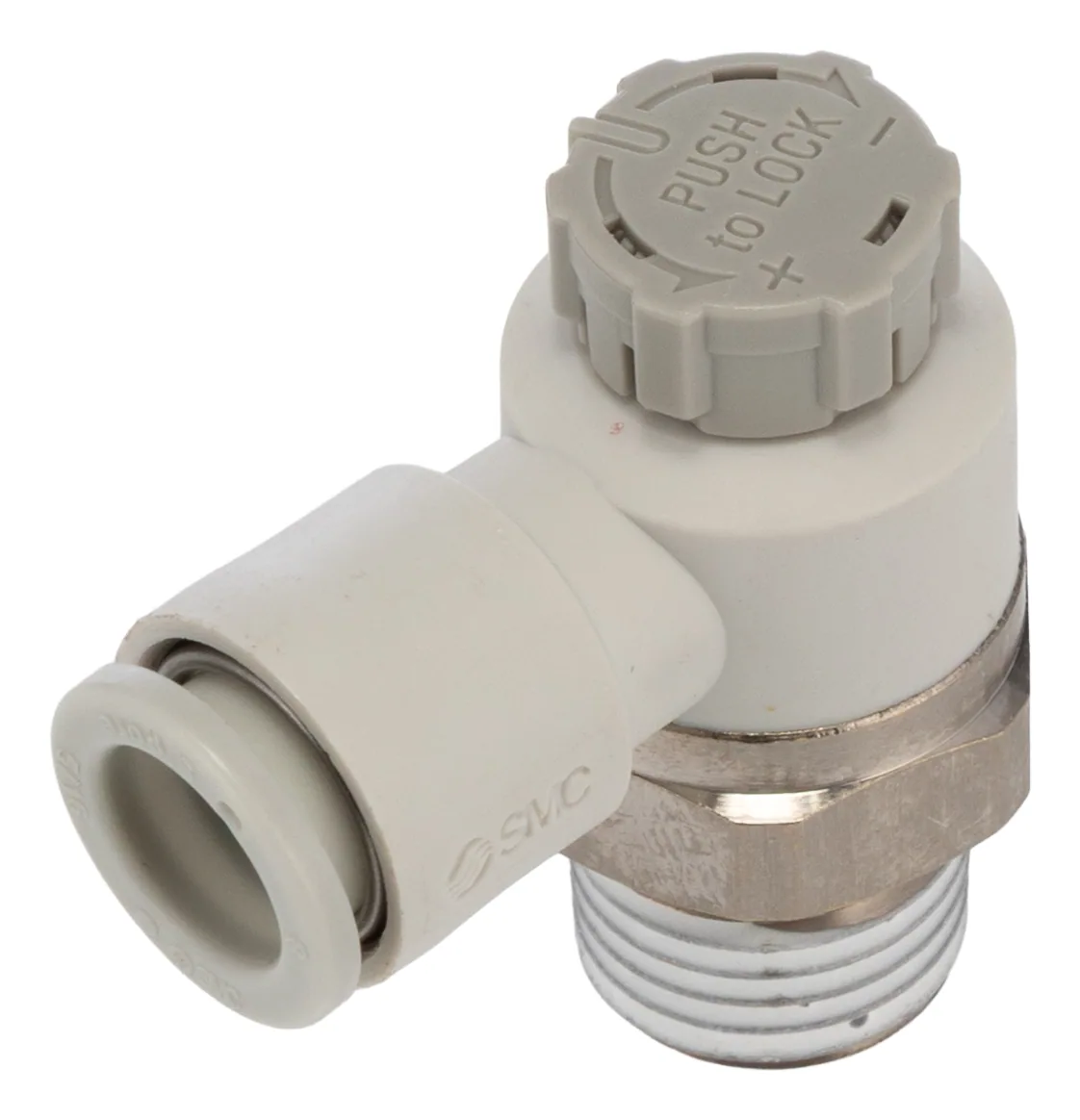
Image copyright belongs to the manufacturers or original authors. Brands and models identify illustrations; consult official documentation when selecting parts.
ENGINEERING GUIDE
Selection and design guide
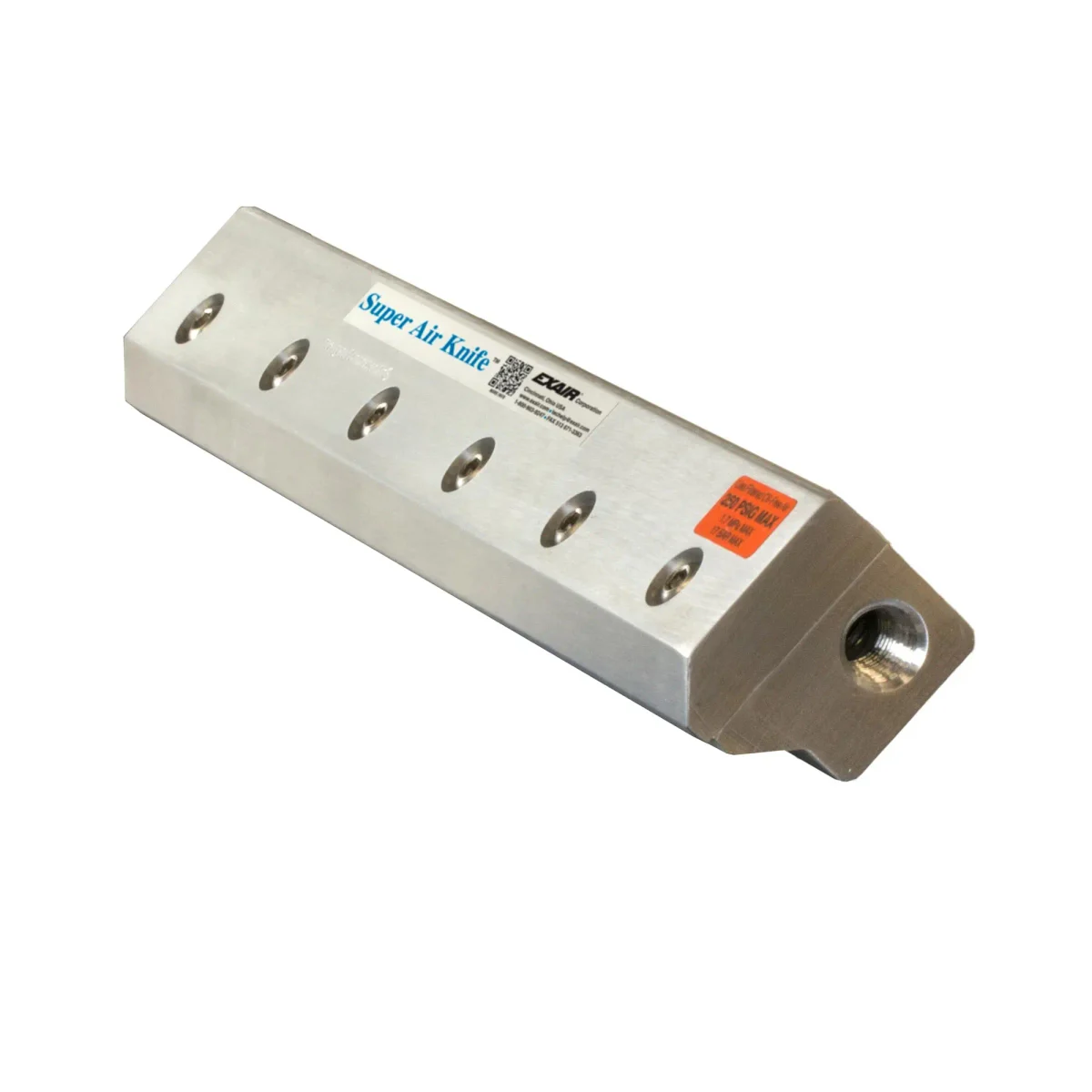
An air knife forces compressed air through a slit that runs the full length of the body and turns the jet along a profiled surface, so that it drags surrounding air with it and forms an even curtain. It is used to blow workpieces dry after washing, to clear conveyor belts, to cool parts and to isolate one zone from another. On the EXAIR Super Air Knife the factory slit is 0.05 mm; at 5.5 bar each 25 mm of length takes 82 SLPM, giving 59.9 m/s at 152 mm from the target, a blow force of 71 g, 69 dB(A) and an entrainment ratio of 40:1. Size it as the length times the consumption per 25 mm, and feed any knife above 24" from more than one inlet.
01Construction and how it works
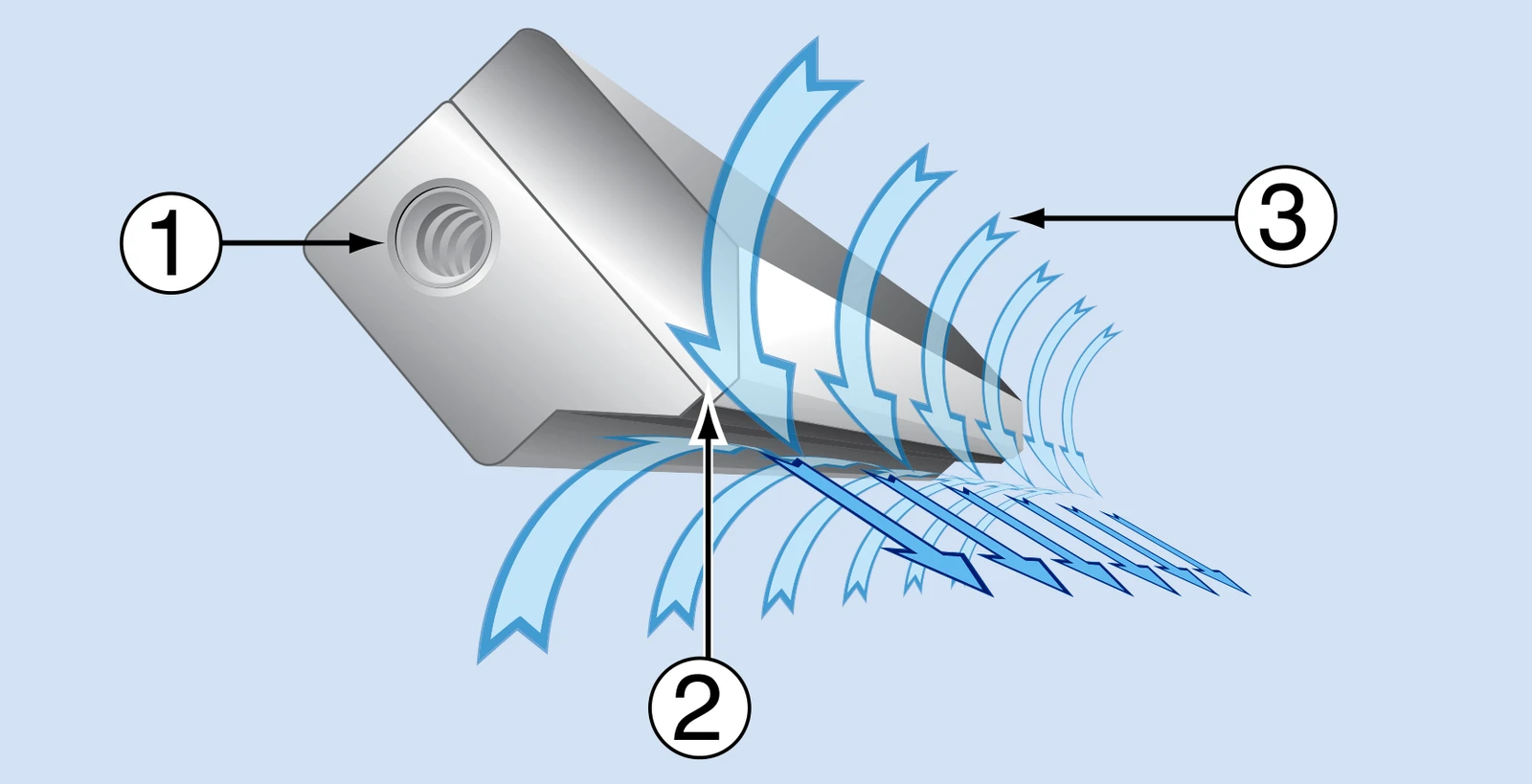
An air knife is a long, narrow body with an internal plenum. Compressed air enters the plenum at an end or through the bottom, and leaves through a slit that runs the full length, its width set by a shim. The primary jet turns along a flat or curved surface (the Coanda effect) and drags a large volume of surrounding air into itself, so that a curtain forms evenly along the whole length. The narrower the slit and the larger the plenum, the more even the air speed along the length.
EXAIR Super Air Knife working principle: (1) compressed air enters the plenum through the inlet; (2) the jet leaves the precision slit and runs straight along the flat surface, forming an even sheet of air over the full length; (3) surrounding air is drawn into the main jet at an entrainment ratio of 40:1, giving a laminar curtain with high volume, strong impact and low shearSource: EXAIR catalogue, Air Knives chapter, catalogue page 22
Entrainment ratio: the ratio of entrained air to compressed air. EXAIR gives 40:1 for the Super Air Knife and 30:1 for the Standard Air Knife and the Full-Flow Air Knife, and states that a drilled pipe or a slit pipe reaches only about 3:1. The higher the ratio, the less compressed air is needed for the same air volume, and the lower the noise, because the jets mix gradually and shear less.
Why it uses less air and is quieter than a drilled pipe: a drilled pipe is a row of holes, with dead zones between the jets, an uneven air speed and noise from high speed jets shearing straight into still air. The holes also block easily. EXAIR states that the Super Air Knife uses about 1/3 of the compressed air of a typical blow-off.
Safety: the EXAIR catalogue states that the slit construction of the Super Air Knife keeps the outlet from being fully blocked. Where compressed air is used for cleaning, verify the dead-end static pressure of the installation as fitted, the effective chip guarding and the personal protection against the regulations that apply.
A blower air knife is a different class: a centrifugal blower supplies low pressure and high volume (about 0.2 bar in the EXAIR comparison test) with no compressed air, but the unit is large and the noise and the maintenance are greater; see the Types section.
02Types and designation systems
Three EXAIR compressed air knives (6" = 152 mm long, 80 psig = 5.5 bar)
Type
Air consumption SCFM / SLPM
Air speed m/s
Blow force per 25 mm
Noise dB(A)
Entrainment ratio
Air inlet
Super Air Knife
17.4 / 492
59.9
2.5 oz / 71 g
69
40:1
Both ends and the bottom; overall length = air length
Standard Air Knife
20.4 / 577
55.9
2.7 oz / 77 g
83
30:1
Both ends; overall length 25 mm longer than the air length
Full-Flow Air Knife
18.6 / 526
50.8
2.3 oz / 65 g
80
30:1
Back face; smallest size
EXAIR Air Knives chapter, catalogue page 32. Air speed and blow force are measured 6" (152 mm) from the target and noise at 3' (914 mm). EXAIR's assessment: the Super has the lowest running cost and is the quietest; the Standard is cheaper but uses the most air and is the noisiest; the Full-Flow is the cheapest and the smallest and suits tight spaces, but the version with inlets at both ends is not recommended where the flow has to be even along the full length.
Drilled pipe (2 pipes, 25 holes of ø1.6 mm each, 13 mm pitch)
174 / 4924
35
91
Flat nozzle
257 / 7273
51
102
Blower air knife (10 hp centrifugal blower, 3 psig)
—
10 (blower motor)
90
Super Air Knife
55 / 1557
11
69
EXAIR Air Knives chapter, catalogue page 23. This is the maker's own comparison test, so the conclusion is not neutral, but the test conditions are given. EXAIR also notes that a blower draws slightly less power but costs more to buy, needs a new filter every 1~3 months and a new belt every 3~6 months, usually new bearings once a year, and takes more floor space and makes more noise; it also cannot be switched on and off with the duty the way compressed air can.
Materials: the EXAIR Super Air Knife comes in aluminium (to 82 °C), 303 stainless steel and 316 stainless steel (to 427 °C, 316 for food, pharmaceutical and corrosive duty) and PVDF (to 135 °C, resistant to acids, alkalis and solvents, up to 54" long); force, flow and air pattern are the same in all four.
Length: standard lengths 3"~108" (76~2743 mm), with special lengths to order; a longer run joins two knives with a coupling bracket so that the curtain is not broken.
Shims: the knife ships with a 0.002" (0.05 mm) red shim, which suits most duties; the aluminium shim set also has 0.001", 0.003" and 0.004" (0.03, 0.08 and 0.10 mm). A thicker shim raises the air speed and the impact, with slightly more air and noise.
Special versions: curved, flat (only 11/16" thick), dual-sided and PVC versions are built to order for particular applications.
03Key parameters
EXAIR Super Air Knife performance (0.05 mm shim, per 25 mm of length)
Supply pressure
Air consumption SCFM / SLPM
Air speed (at 152 mm)
Noise dB(A) (at 914 mm)
Blow force (at 152 mm)
20 psig / 1.4 bar
1.1 / 31
5000 fpm / 25.4 m/s
57
0.6 oz / 17 g
40 psig / 2.8 bar
1.7 / 48
7000 fpm / 35.6 m/s
61
1.1 oz / 31 g
60 psig / 4.1 bar
2.3 / 65
9600 fpm / 48.8 m/s
65
1.8 oz / 51 g
80 psig / 5.5 bar
2.9 / 82
11 800 fpm / 59.9 m/s
69
2.5 oz / 71 g
100 psig / 6.9 bar
3.5 / 99
13 500 fpm / 68.5 m/s
72
3.2 oz / 91 g
EXAIR Air Knives chapter, catalogue page 24, measured on a 12" (305 mm) knife. Air consumption and blow force are given per inch (25 mm) of length, and the noise is that of the whole knife.
EXAIR Standard Air Knife performance (0.05 mm slit, per 25 mm of length)
Supply pressure
Air consumption SCFM / SLPM
Air speed (at 152 mm)
Noise dB(A)
Blow force
20 psig / 1.4 bar
1.3 / 37
20.3 m/s
65
0.45 oz / 13 g
40 psig / 2.8 bar
2.0 / 57
29.5 m/s
74
1.1 oz / 31 g
60 psig / 4.1 bar
2.7 / 76
43.2 m/s
80
2.0 oz / 57 g
80 psig / 5.5 bar
3.4 / 96
55.9 m/s
83
2.7 oz / 77 g
EXAIR Air Knives chapter, catalogue page 34. At the same pressure it uses about 17% more air than the Super Air Knife and is 14 dB(A) noisier.
For comparison: air consumption of one hole in a drilled pipe (SCFM / SLPM)
Supply pressure
ø1.59 mm hole
ø2.38 mm hole
ø3.18 mm hole
ø4.76 mm hole
ø6.35 mm hole
20 psig / 1.4 bar
1.4 / 40
3.5 / 99
6.4 / 181
14.5 / 410
25 / 710
40 psig / 2.8 bar
2.2 / 62
5.4 / 153
10.2 / 289
22.9 / 648
40 / 1132
60 psig / 4.1 bar
3.0 / 85
7.4 / 209
14 / 396
31 / 877
54 / 1528
80 psig / 5.5 bar
3.8 / 108
9.4 / 266
17.5 / 495
39.5 / 1118
69 / 1953
100 psig / 6.9 bar
4.6 / 130
11.5 / 326
21.5 / 609
47.5 / 1344
84 / 2363
EXAIR Air Knives chapter, catalogue page 24. Use it to estimate the air of the drilled pipe that is being replaced.
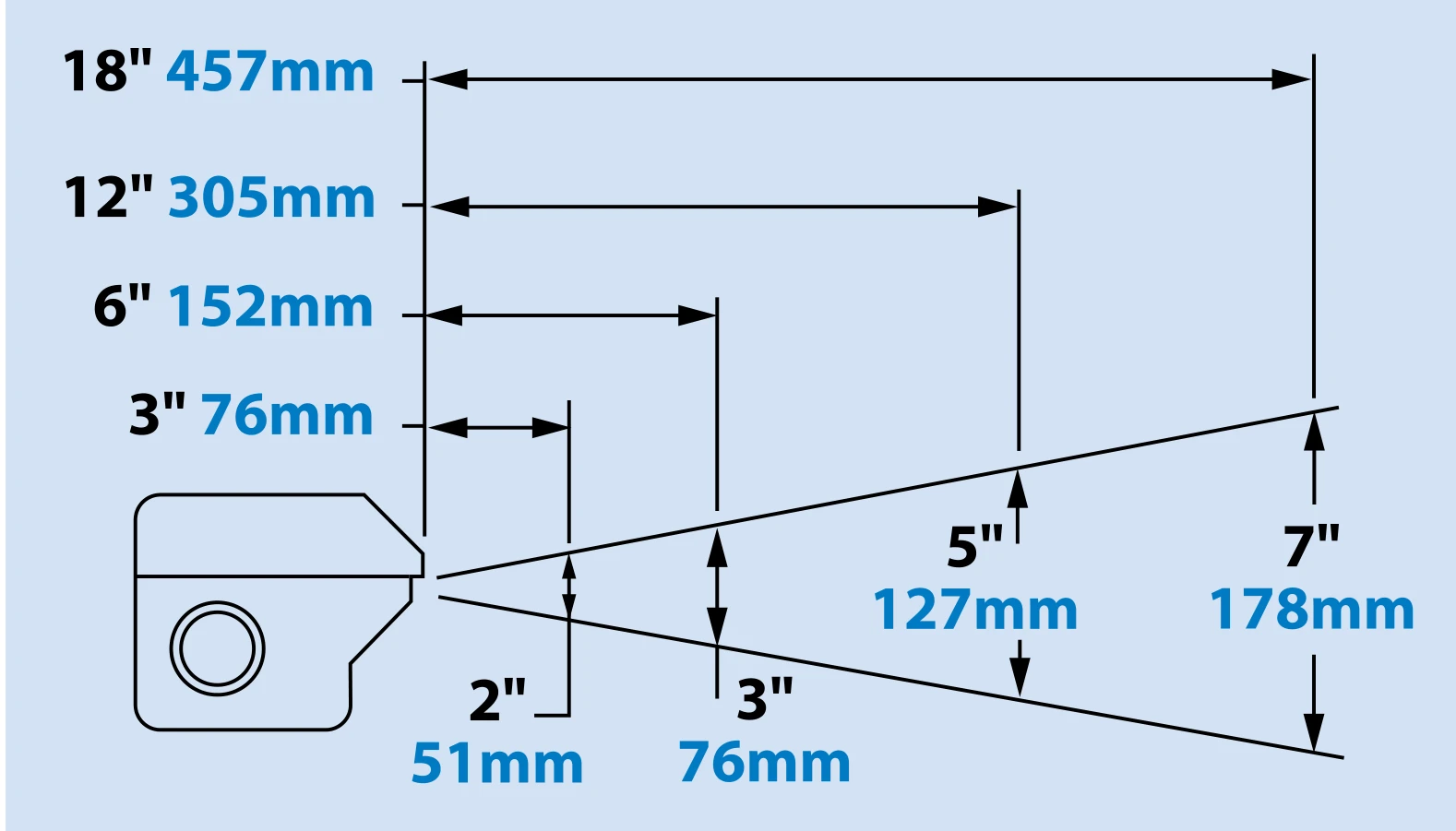
Super Air Knife air pattern: the curtain thickens as it leaves the slit. It is about 2" (51 mm) at 3" (76 mm) from the outlet, about 3" (76 mm) at 6" (152 mm), about 5" (127 mm) at 12" (305 mm) and about 7" (178 mm) at 18" (457 mm).Source: EXAIR catalogue, Air Knives chapter, catalogue page 24
Maximum noise exposure permitted by OSHA (quoted in the EXAIR catalogue)
Duration per day
8 h
7 h
4 h
3 h
2 h
1 h
0.5 h
Sound level dB(A)
90
91
95
97
100
105
110
EXAIR Air Knives chapter, catalogue page 22, credited there to OSHA 29 CFR 1910.95(a).
04Outline, ports and mounting space
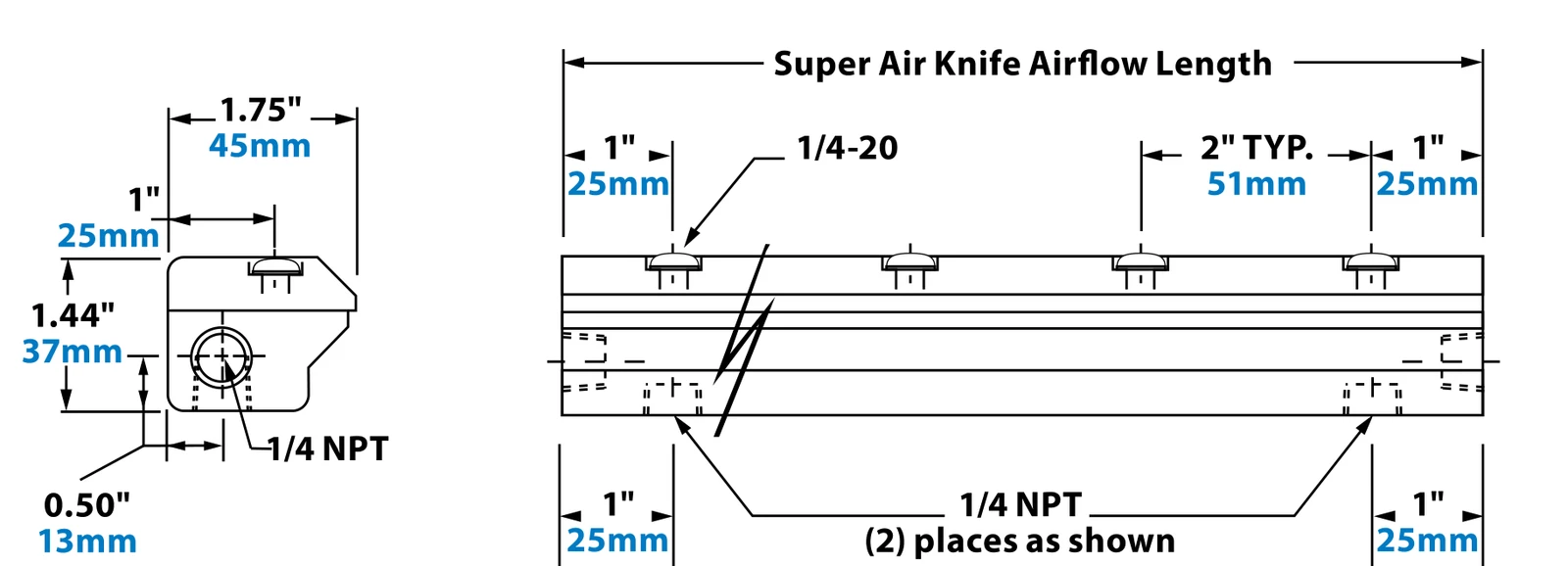
Take the EXAIR aluminium Super Air Knife. The air length of the knife equals the overall length of the body. The layout therefore has to fix the section size, the position and number of the air inlets, the mounting screw holes, and the distance and angle to the workpiece. It also fixes where the water and chips that are blown off will go.
EXAIR aluminium Super Air Knife outline. On the left the end section, 1.75" (45 mm) wide and 1.44" (37 mm) high, with a 1/4 NPT inlet in the end face 0.50" (13 mm) from the back and a screw above it 1" (25 mm) from the back. On the right the front view, where the air length is the overall length, with 1/4-20 screws 1" (25 mm) from each end and 2" (51 mm) apart, and two 1/4 NPT inlets in the bottom, each 1" (25 mm) from an end.Source: EXAIR catalogue, Air Knives chapter, catalogue page 30
Number of air inlets on the EXAIR Super Air Knife, by length
Knife length
Inlets that must be supplied
Under 24" (under 610 mm)
The catalogue states no number (inlets at both ends and in the bottom are available)
24"~47" (610~1194 mm)
1 at each end
48"~59" (1219~1499 mm)
Both ends + 1 in the middle of the bottom
60"~83" (1524~2108 mm)
Both ends + 2 equally spaced in the bottom
84" and above (2134 mm~)
Both ends + 3 equally spaced in the bottom
EXAIR Air Knives chapter, catalogue page 24, Compressed Air Inlets. EXAIR offers a Plumbing Kit for knives above 24", which links the inlets with hose or stainless steel pipe of a suitable size; the aluminium kit includes a pressure gauge to monitor the pressure at the knife.
Section: the aluminium knife is 45 mm × 37 mm; the stainless version is smaller, marked 1.44" (37 mm) and 1.03" (26 mm) on the drawing, with the bottom inlets 2" (51 mm) from each end. Check the CAD drawing on the EXAIR website for the actual figure.
Mounting: EXAIR states that the air supply pipe alone can carry the knife, and that there are also 1/4-20 tapped holes in the bottom; the 9060 universal mounting bracket is stainless steel and reaches 30" at most, with a ø1/2" hole or a 1/2-13 tapped hole, taking two brackets for a 24"~54" knife, three for 55"~71", four for 72"~95" and five above 96".
Distance and coverage: the further away, the thicker and the slower the curtain (see the air pattern drawing above). The speeds and forces in the performance tables are measured 152 mm from the target, so keep the knife within that distance in the layout, and leave room to adjust the angle and the distance (with a universal bracket or slotted holes).
Side by side: on the Super Air Knife the overall length equals the air length, so knives can be butted end to end for an unbroken curtain; on the Standard Air Knife the body is 25 mm longer than the air length, so a short gap is left between neighbours.
Drainage and baffles: the water, oil and chips that are blown off have to go somewhere. In the EXAIR bottle and crate drying case, 3 knives, each 18" long, blow at an angle against the direction the parts come from, driving the water down towards the floor. Allow a drip tray, a baffle or an extraction hood downstream of the knife.
Supply pipe size: an air knife uses a lot of air. A 1 m Super Air Knife takes about 3200 SLPM at 5.5 bar, as the worked example in the next section shows. The supply pipe, the solenoid valve, the regulator and the filter are therefore all sized for the total flow and kept as close to the knife as possible. EXAIR accessories include three groups. Auto drain filters 9001 (3/8 NPT, 65 SCFM), 9032 (1/2 NPT, 90 SCFM) and 9002 (3/4 NPT, 220 SCFM). Regulators 9008 (1/4 NPT, 50 SCFM), 9033 (1/2 NPT, 100 SCFM) and 9009 (3/4 NPT, 220 SCFM). Solenoid valves 9020 (1/4 NPT, 40 SCFM), 9034 (1/2 NPT, 100 SCFM), 9036 (3/4 NPT, 200 SCFM) and 9065 (1 NPT, 350 SCFM).
05Selection and calculation
Fix the lengthThe curtain has to cover the full width of the workpiece or the conveyor, with a little to spare at each side; above 108" use two knives butted together.
Fix the materialAluminium is usual; stainless steel for high temperature, food and corrosive duty; PVDF for strong acids and alkalis, plating and battery work.
Fix the pressureStart at a lower pressure and stop when it is enough. EXAIR: a regulator gives stepless control of flow, blow force and air consumption; if the force is short, fit a thicker shim or raise the pressure.
Work out the air consumptionRead the consumption per 25 mm from the table and multiply by the length in inches to get the total. Work out the average from the cycle time and the duty cycle, and add it to the machine total.
Lay out the air supplySize the filter, the regulator, the solenoid valve and the supply pipe for the total flow; feed knives above 24" at more than one inlet; switch the air with a solenoid valve and a photoelectric sensor, so that it blows only while a part passes.
Fix the positionKeep the distance within 152 mm where possible, blow at an angle against the direction the part comes from, and allow for catching the water and the chips downstream.
q_v = q_u · L / 25.4
q_v
Total air consumption of the knife, SLPM (subscript v, volume flow)
q_u
Air consumption per inch (25.4 mm) of length, SLPM, read from the performance table (82 for the Super Air Knife at 5.5 bar) (subscript u, unit length)
L
Air length of the knife, mm
EXAIR Air Knives chapter, catalogue page 24, How To Calculate Air Savings. Worked example: a 1 m (about 39") Super Air Knife at 5.5 bar gives q_v = 82 × 1000 / 25.4 ≈ 3230 SLPM, about 3.2 m³/min; with 2 s of blowing per part and 10 parts a minute, a duty cycle of 1/3, the average is about 1.1 m³/min.
Use clean air: EXAIR stresses that clean air is essential, and the knife kit includes an auto drain filter with a 5 µm element. The slit is only 0.05 mm, and dirt blocks part of it to leave streaks.
Feed at several inlets: connect the inlets as the table above requires, and link them with pipe of a suitable size, rather than feeding one end and leaving the other dead.
Set the pressure: fit a regulator and a gauge near the knife, start low and raise the pressure until the part is just clean.
Change the shim: a thicker shim (0.003", 0.004") gives more impact, with more air and noise; go back to 0.002" when it is not needed.
Angle and distance: blow at an angle against the direction the part travels, so that water and chips are driven one way; start within 152 mm and adjust from there.
Blow on demand: switch the air with a solenoid valve and a photoelectric sensor, so that it blows only when a part is in place. In the EXAIR cake icing case a photoelectric sensor watches the gap and opens an 18" stainless knife at the exact moment to cut the icing band.
Air curtain isolation: a knife also makes an open "air wall", for example to keep a camera or a laser lens clear of flying chips, or to drive smoke towards an extractor hood on both sides of an engine test bed.
Different effect at the two ends, weak in the middle
A long knife fed from one end only; supply pipe too small, so the pressure at the knife is low
Feed the number of inlets the length requires; check the pressure at the knife with a gauge; enlarge the supply pipe and the valve
Streaks in the curtain, no air in places
Dirt or oil sludge blocking the slit; shim damaged or out of place
Improve the filtration; open the knife and clean the slit, check the shim
Will not blow clean
Too far away or at the wrong angle; pressure too low; parts moving too fast
Move within 152 mm; adjust the angle; raise the pressure or fit a thicker shim; add a second knife
Loud
Pressure too high; a Standard or Full-Flow knife; the curtain hitting a hard edge
Reduce the pressure; change to the Super type; adjust the angle
Air consumption above budget
Blowing continuously; pressure set too high
Switch with a solenoid valve on demand; reduce the pressure to what is needed
Compiled from the notes and cases on catalogue pages 20~34 of the EXAIR Air Knives chapter. EXAIR states that the Super Air Knife has no moving parts and is virtually maintenance free, and that day to day maintenance is draining the filter and changing the element.
08Common design mistakes
Using a drilled pipe instead of an air knife. In the EXAIR comparison test the drilled pipe used more than 3 times the air of the Super Air Knife (174 against 55 SCFM) and made 91 against 69 dB(A), and its air speed was uneven; a hole can also be blocked by hand, which fails 1910.242(b).
Feeding a long knife from one end. Above 24" both ends must be fed, and above 48" the bottom inlets as well, or the far end loses a lot of air.
Choosing the supply pipe by the port thread. A 1/4 NPT inlet does not mean a 1/4 pipe is enough; a 1 m knife takes about 3200 SLPM, so the pipe, the valve and the regulator are sized for the flow, or the pressure at the knife drops.
Mounting the knife too far from the workpiece. Air speed falls with distance and the curtain grows thicker and weaker; the performance tables are all at 152 mm.
Blowing continuously. Air blown between parts is the largest waste. Trigger the solenoid valve from a sensor.
Not thinking about where the blown material goes. Water, oil and chips end up on the guideways, in the electrical cabinet or on the operator. Allow a drip tray, a baffle or extraction downstream.
Running beyond the temperature of the material. Aluminium stops at 82 °C; an oven mouth or a hot part needs the stainless version (to 427 °C).
Where compressed air is used for cleaning, the outlet gauge pressure in a blocked, static condition must stay below 30 psig, with effective chip guarding and personal protection
OSHA 29 CFR 1910.95
Permitted occupational noise exposure time (see Key parameters)
ISO 8573-1
Compressed air quality classes, which can be used to state the particle, water and oil class of the air supplied to a knife
The OSHA clauses apply to workplaces within their jurisdiction; check the equipment against the occupational safety and health requirements of the place where it is used.
EXAIR: Super Air Knife (110003~1100108, aluminium; SS, SS-316 and PVDF versions; the DX Deluxe kit with electronic flow control EFC and a universal bracket; the PKI with a plumbing kit), Standard Air Knife (3"~48"), Full-Flow Air Knife, 9060 universal bracket, 110900 coupling bracket, 9076~9079 and 9240~9250 plumbing kits.
Silvent, Nex Flow and others also make compressed air knives; blower air knives come from specialist makers. Take air consumption, speed and noise from each catalogue, and check that the measuring distance and the pressure are the same when comparing.
EXAIR catalogue, Air Knives chapter ↗Catalogue pages 20~21 Super Air Knife features, materials and lengths; 22 working principle, OSHA noise table, note on 30 PSIG dead-end pressure and blower comparison; 23 blow-dry comparison test (60 psig); 24 performance tables, drilled pipe consumption table, air pattern drawing, consumption worked example, inlet numbers, mounting, shims; 26 material temperature limits; 29 universal bracket, coupling bracket and plumbing kits; 30 outline dimensions; 32 comparison of the three knives and accessories (filter, regulator, solenoid valve); 33~34 Standard Air Knife principle and performance. The original EXAIR catalogue chapter as published via RS
Tables and formulas are rearranged from the sources above. Verify against the current standard and the manufacturer catalogue before finalising a design. Updated 2026-11-25
ONLY ON MECHWIKI / SELECT · BUY · MAINTAIN
Buying and using: calculators, sellers, uses
The notes below cover the “Fittings & accessories” category. MechWiki prepared these category notes from public standards and engineering references. Use the selected manufacturer’s catalog for ratings, life factors and dimensions.
TOOLS / CALCULATE
Related selection calculators
Use these calculators for a preliminary estimate, then verify the result against this entry, the manufacturer catalogue and installation limits. Results do not replace a specific model rating.
The directory links to manufacturer selection and CAD resources and identifies the maker of the pictured example. Check stock and lead time with the supplier. Price comparison and ranking are not available yet.
SMCPneumatic actuators, controls, vacuum and fluid-control components.