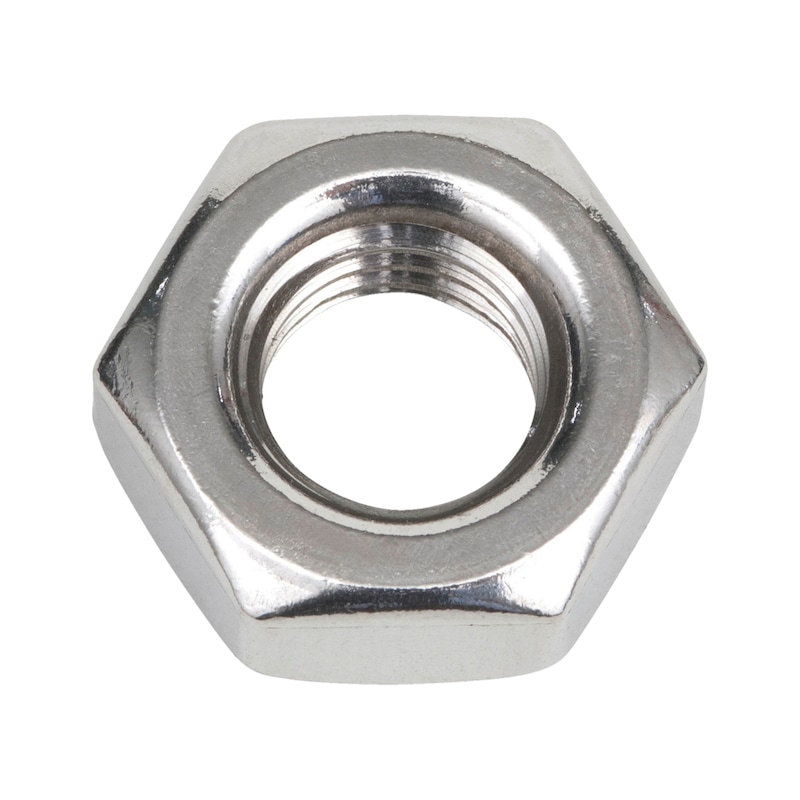
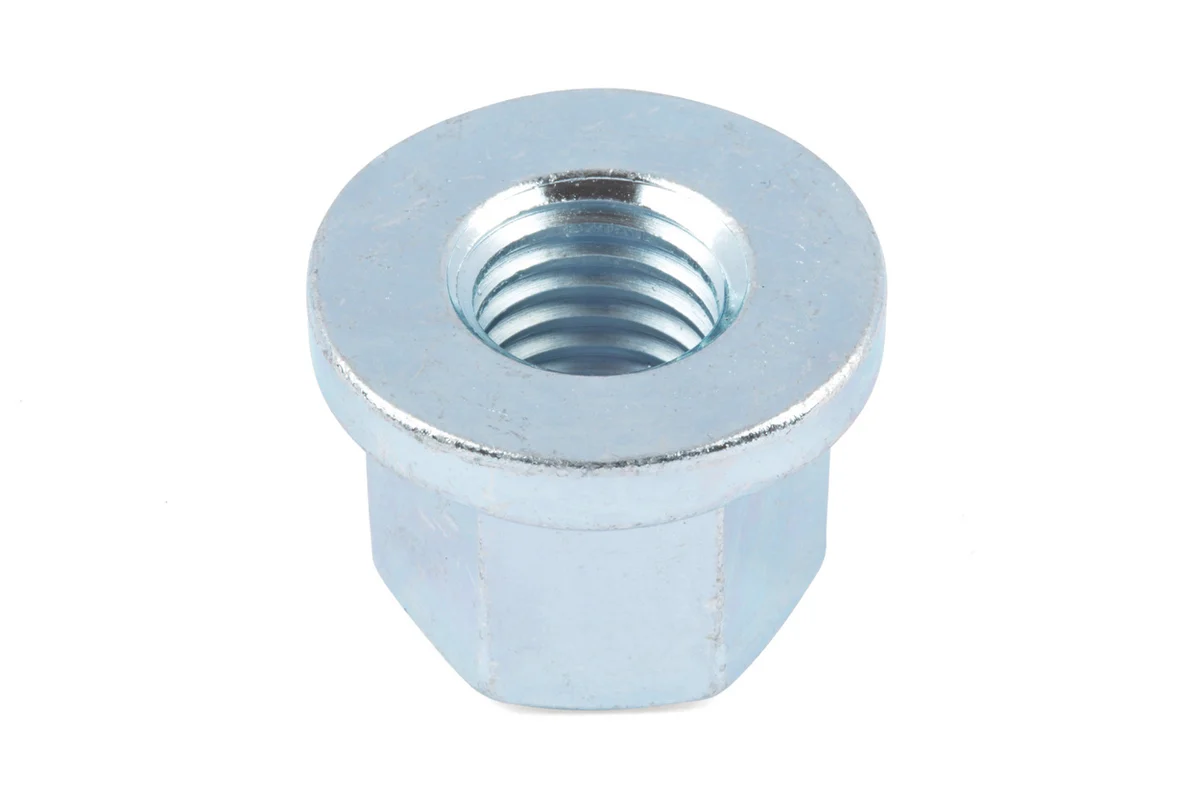
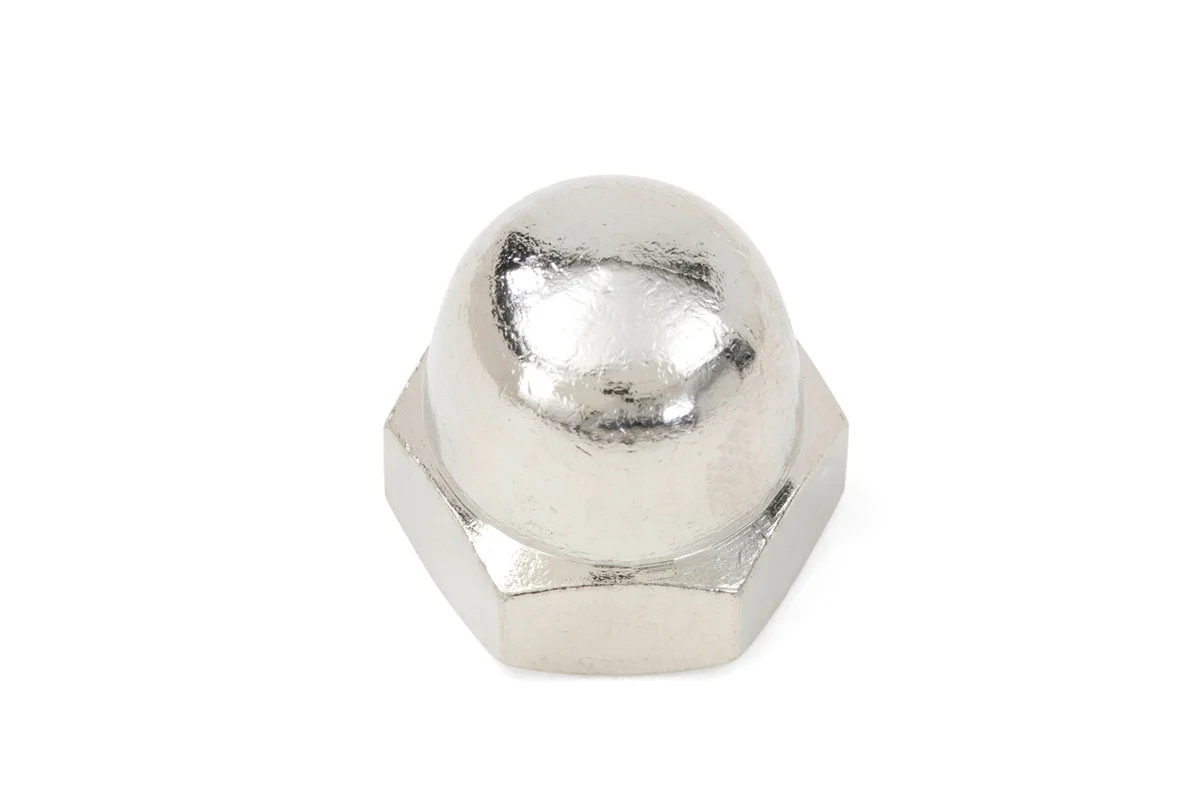
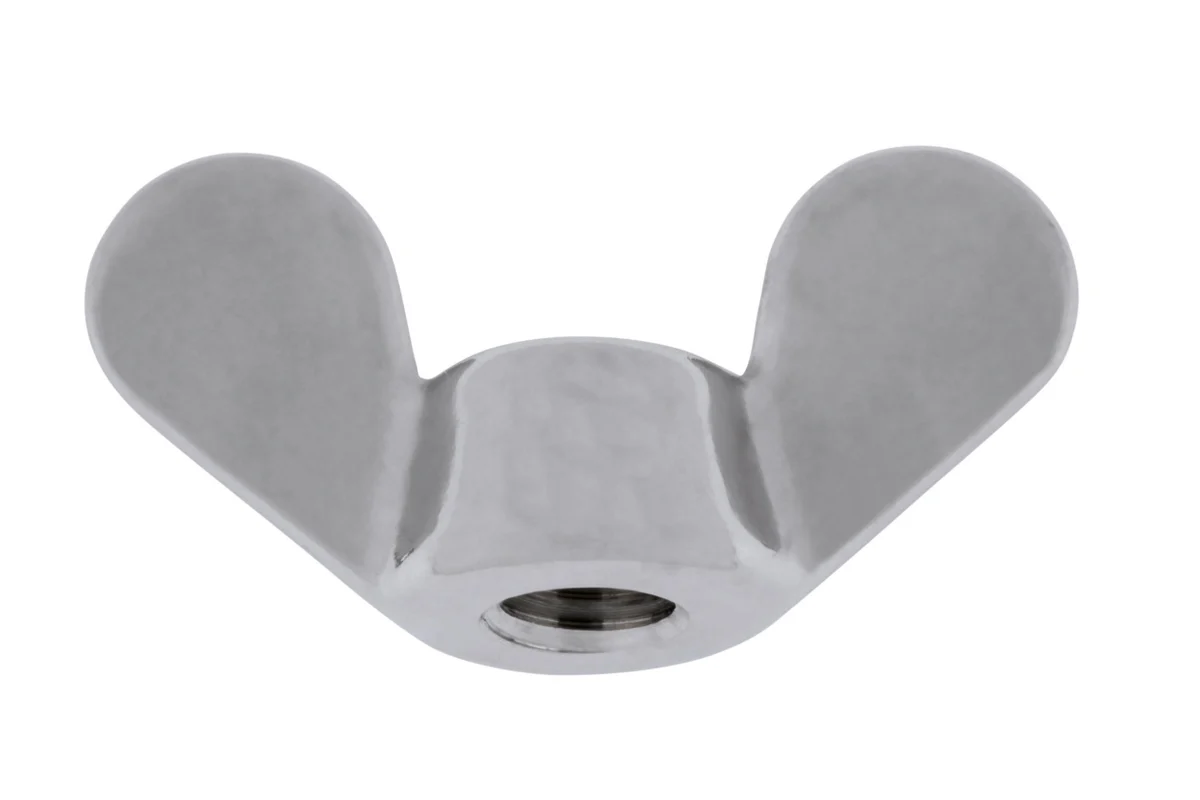
Image copyright belongs to the manufacturers or original authors. Brands and models identify illustrations; consult official documentation when selecting parts.
ENGINEERING GUIDE
Selection and design guide
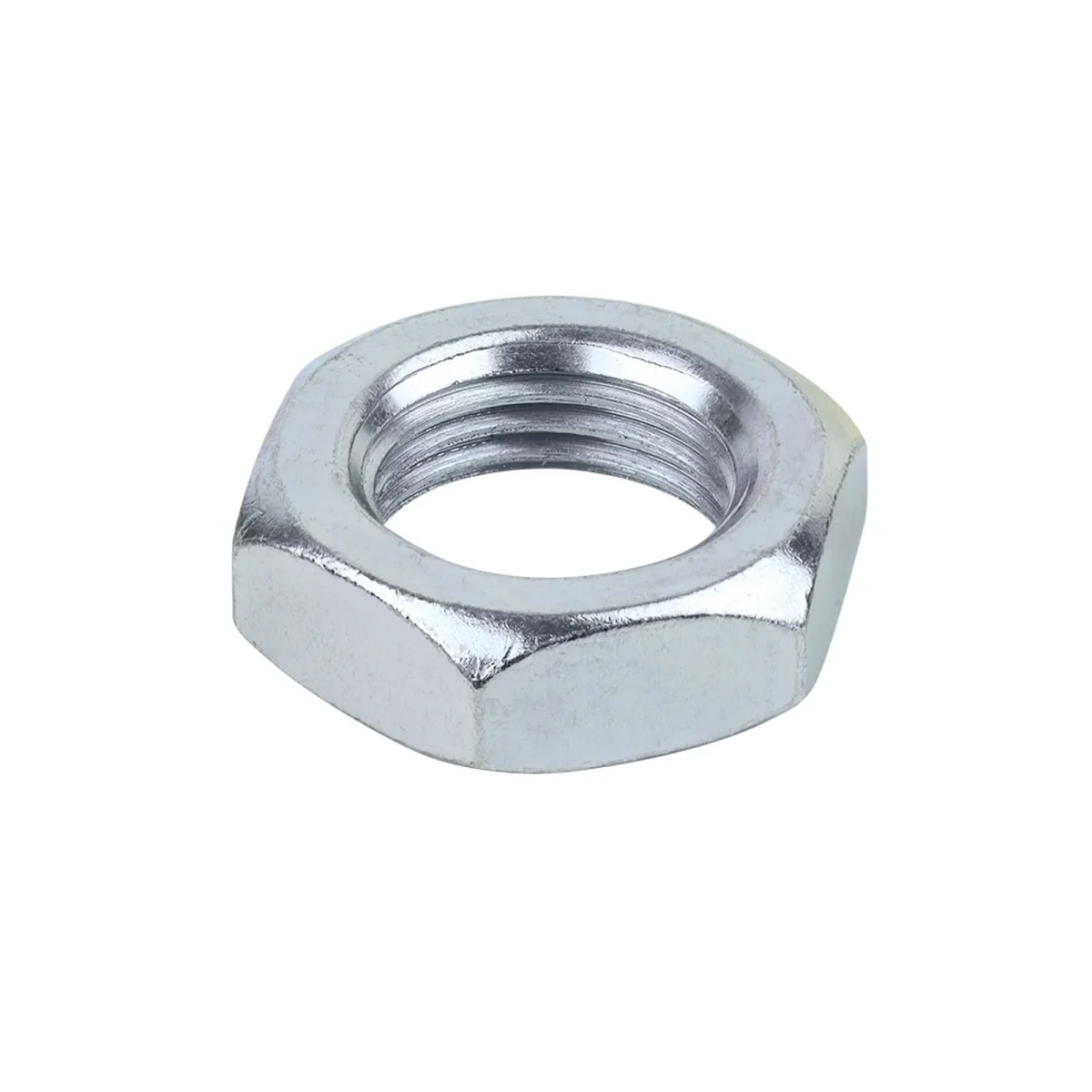
A hex nut about half the thread diameter in height (ISO 4035 chamfered, ISO 4036 unchamfered, formerly DIN 439). Take the Mädler ISO 4035 as an example: M10 is 5 mm high with a 16 mm across-flats, while an ISO 4032 plain nut at M10 is 8.4 mm high. Steel thin nuts come in only two classes, 04 and 05, and in the Würth table a class 04 nut on a class 8.8 bolt can strip at a bolt stress of about 300 MPa, far below the bolt yield point. A thin nut therefore cannot carry the full preload; it is used mainly as the nut nearest the clamped part in double-nut locking, or as an adjustment nut where axial space is tight and the load is small.
01Construction and how it works
A thin nut (also called a jam nut) has the same hex across-flats as a plain nut, with the height pressed down to about 0.5d. Bolt tension reaches the nut through the few engaged threads, so halving the height halves the number of engaged threads and the ability of the thread to resist stripping falls with it. The Würth technical handbook gives nuts with a height ≥ 0.5d and < 0.8d a section of their own, and states that when such a nut is used with a bolt of higher strength class, stripping of the nut thread can be expected.
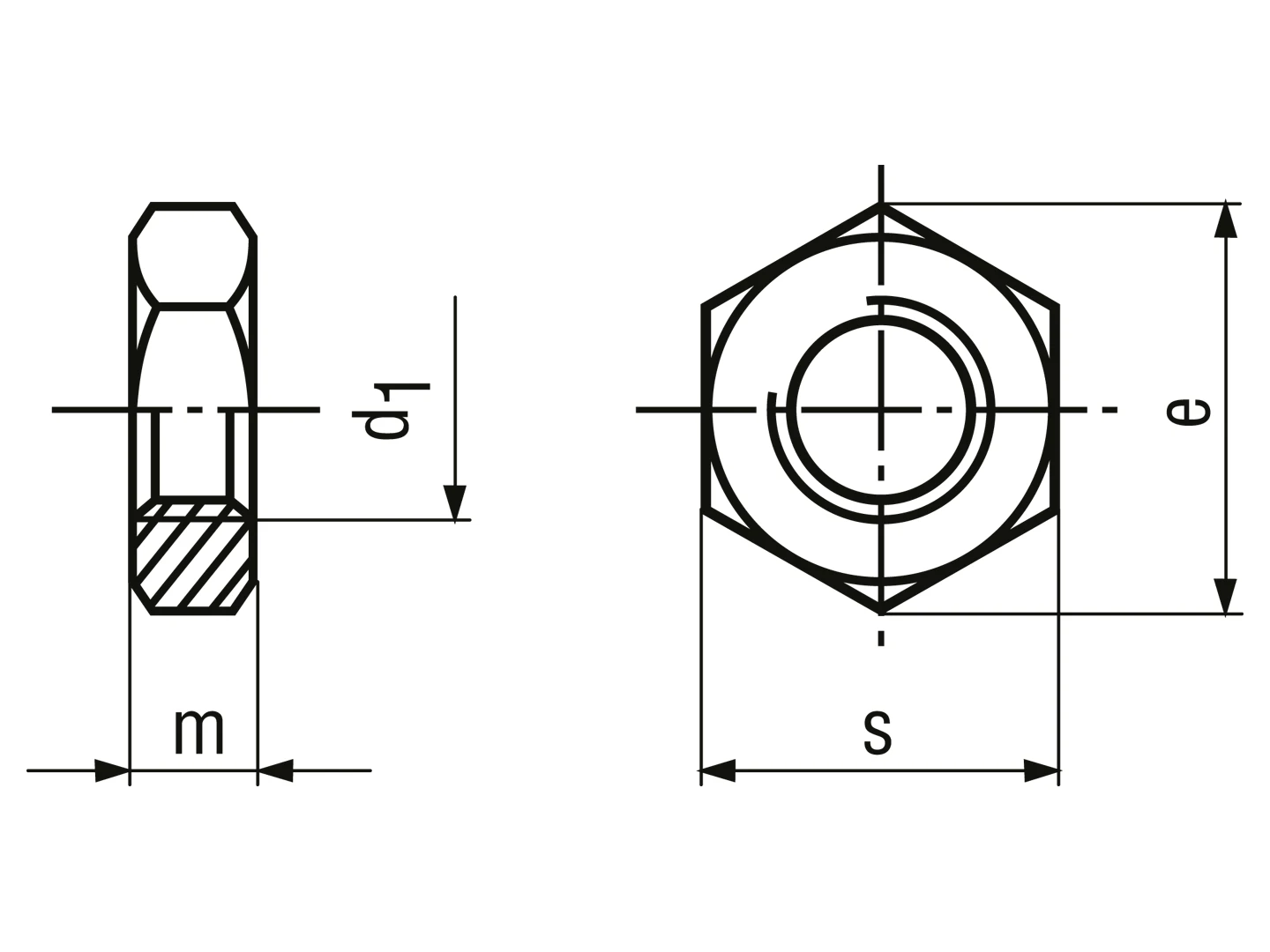
Dimension symbols for a hex thin nut (DIN 439 B, roughly equivalent to ISO 4035, chamfered at both ends). Left: section, where m is the nut height and d1 the thread size; right: end view, where s is the across-flats width and e the corner widthSource: Bossard, Hex jam nuts ~0,5d, BN 123 product page dimension drawing
The strength system of a thin nut therefore differs from that of a plain nut. On a plain nut (height ≥ 0.8d) the class number gives the highest bolt class it can be paired with, and with the right pairing the bolt can be taken to its yield point. A thin nut has only two classes, 04 and 05, and the leading 0 marks reduced load capacity. The Würth handbook states in its notes on steel nuts that a class 8.8 bolt with a class 8 nut can be loaded to the bolt yield point, and that this does not hold for load-limited nuts such as classes 04 and 05.
The most common use of a thin nut is double-nut locking. Bolt Science explains the arrangement as follows: fit the thin nut first, then run a plain nut on outside it while holding the thin nut still. As the outer nut is tightened, the thread face of the thin nut that was carrying load is gradually unloaded, and the bolt thread instead bears on the opposite flank of the thin nut thread, so the two nuts wedge the thread between them. Self-loosening needs relative sliding between the bolt and nut threads, and once the thread is wedged that sliding is blocked. The locking is of the friction type, and Nord-Lock also classes the double nut as a friction method.
Replaces DIN 439 part 2 (type B, chamfered); steel classes 04 and 05, stainless steel A2-035
ISO 4036
Hex thin nut, unchamfered
Replaces DIN 439 part 1; smaller size range, refer to the standard text
ISO 8675
Hex thin nut, fine thread
Mädler supplies M8×1~M24×2; M24×1.5 is not covered by ISO 8675
DIN 439 B
German standard thin nut (withdrawn)
The Bossard product page marks it Standard withdrawn ~ISO 4035; the market still orders heavily to it
GB/T 6172.1, GB/T 6174
National standard hex thin nut (chamfered / unchamfered)
See the hex nut article; the current edition applies
GB/T 6172.2, ISO 10511
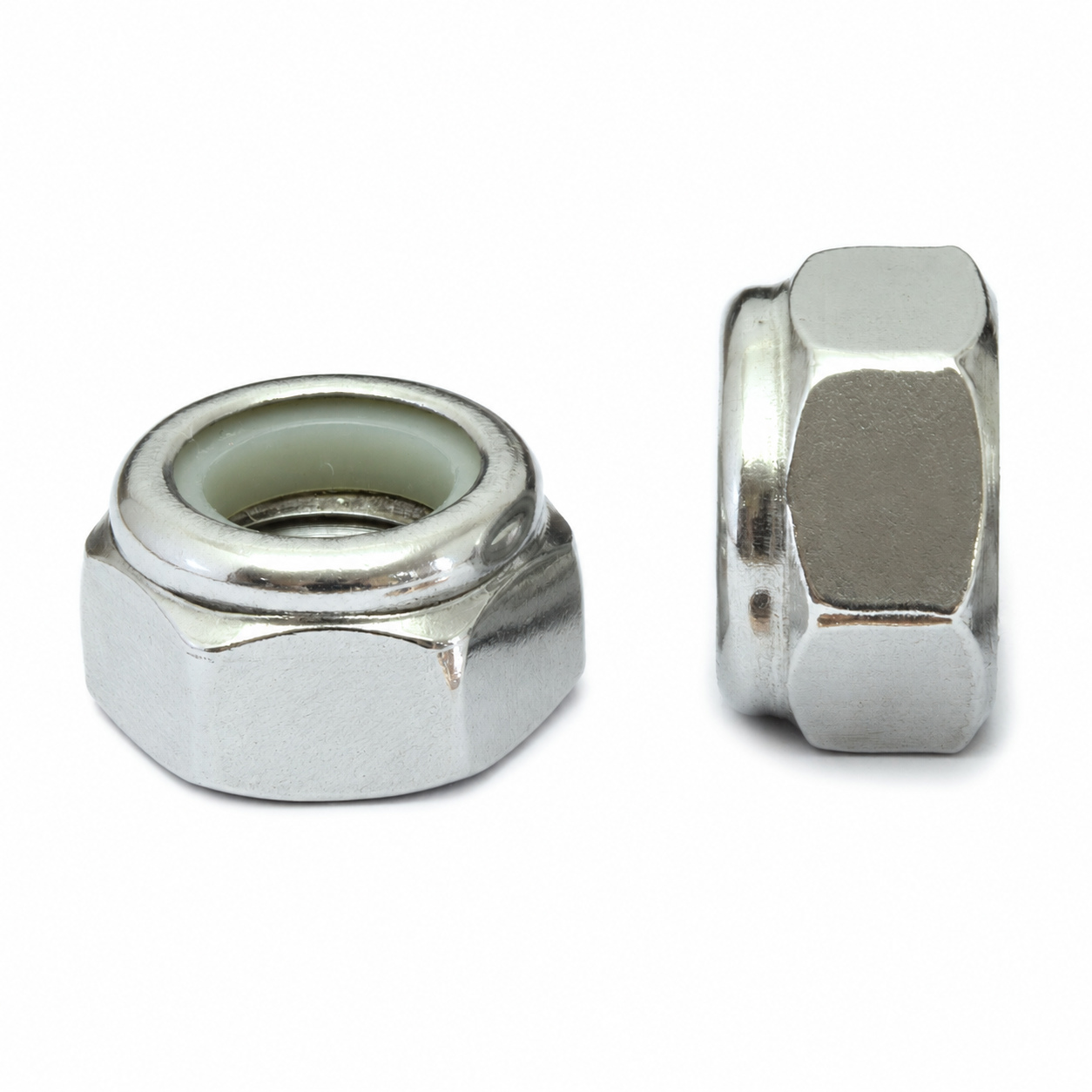
Thin lock nut with non-metallic insert
Nylon insert type, see the nylon insert lock nut article
The DIN to ISO correspondence comes from chapter 3, section 3.4.5 of the Würth DIN catalogue technical part (DIN 439 T1 → ISO 4036, DIN 439 T2 → ISO 4035, with the change listed as 4 across-flats). ISO 8675 and stainless steel A2-035 come from the Mädler catalogue K44_N81, and the withdrawn status of DIN 439 B from the Bossard BN 125 product page.
Sizes whose across-flats changed from DIN to ISO (mm)
Size
DIN across flats s
ISO across flats s
M10
17
16
M12
19
18
M14
22
21
M22
32
34
From Würth chapter 3, section 3.3, DIN-ISO across-flats changes. Würth chapter 3 states that the only change from DIN 439 to ISO 4035 is the across-flats width; the Mädler catalogue states that for some sizes both the across-flats and the height differ. The two sources disagree, so take the height from the catalogue of the purchased part.
Strength classes: steel thin nuts are class 04 (the most common; Bossard BN 123/124/125 and the Mädler 652 series are all class 04) and class 05; stainless steel thin nuts are A2-035 and A4-035 (the Mädler catalogue lists A2-035). The Würth handbook also notes that nuts marked by hardness, such as 14H and 22H, likewise belong to the load-limited group.
03Key parameters
ISO 4035 thin nut against ISO 4032 plain nut, dimensions (mm)
Size
Thread pitch P
Across flats s
Thin nut height m max
Plain nut height m max (ISO 4032)
Thin nut weight per 100 pcs (kg)
M6
1
10
3.2
5.2
0.14
M8
1.25
13
4
6.8
0.31
M10
1.5
16
5
8.4
0.54
M12
1.75
18
6
10.8
0.79
M16
2
24
8
14.8
1.7
M20
2.5
30
10
18
3.44
P, s, m and the weight of the thin nut come from the Mädler catalogue K44_N81 table ISO 4035 mit metrischem Gewinde, rechtsgängig (class 04 steel, s and m are maximum values); the ISO 4032 heights come from the table in chapter 3, section 3.5 of the Würth catalogue (upper limit of m min~max). A thin nut is about 55%~60% of the height of a plain nut.
Proof load of thin nuts, plain nuts and a class 8.8 bolt (N)
Size
Class 04 thin nut
Class 05 thin nut
Class 8 style 1 nut
Class 8.8 bolt
M6
7640
10000
17200
11600
M8
13900
18300
31800
21200
M10
22000
29000
50500
33700
M12
32000
42200
74200
48900
M16
59700
78500
138200
91000
Nut proof loads come from chapter 1, table 6 of the Würth catalogue (extract from DIN EN 20898-2, nut test force = As × Sp, Sp 380 MPa for class 04 and 500 MPa for class 05); bolt proof loads come from table 3 in the same chapter (extract from DIN EN ISO 898-1). The proof load of a class 04 thin nut is only about 65% of that of a class 8.8 bolt, and about 86% for class 05; a class 8 plain nut is about 50% above the bolt.
Minimum bolt stress before stripping when a thin nut is paired with bolts of each class (MPa)
Nut class
Nut proof stress
With class 6.8
With class 8.8
With class 10.9
With class 12.9
04
380
260
300
330
350
05
500
290
370
410
480
From chapter 1, table 8 of the Würth catalogue (extract from DIN EN 20898 part 2, reference values for thread stripping of nuts with a height ≥ 0.5d and < 0.8d). For comparison, the yield point of a class 8.8 bolt is 640 MPa (table 5 of the same chapter, 20 °C). In other words, with a class 04 thin nut on a class 8.8 bolt, the thread can strip when the bolt stress has reached only about half the yield point.
04Boundary dimensions and mounting space
The examples use the dimensions of the Mädler ISO 4035 thin nut (class 04), the ISO 4032 plain nut heights given by Würth, and the outside diameter of the Stahlwille 1/2 in. socket. What a thin nut saves is axial length; its radial size, across flats and across corners, matches a plain nut of the same size. Double-nut locking also has to find room for two wrenches at once.
Axial length with double-nut locking (mm)
Size
Thin nut m
Plain nut m (ISO 4032)
Thin + plain stacked height
Two plain nuts stacked
Bolt protrusion past the outer nut
M6
3.2
5.2
8.4
10.4
≥ 2P = 2
M8
4
6.8
10.8
13.6
≥ 2P = 2.5
M10
5
8.4
13.4
16.8
≥ 2P = 3
M12
6
10.8
16.8
21.6
≥ 2P = 3.5
M16
8
14.8
22.8
29.6
≥ 2P = 4
Heights come from the Mädler catalogue and the tables in chapter 3 of the Würth catalogue; the stacked heights are the sum of the two (washers not counted). The last column takes twice the pitch as the bolt protrusion, following the Mädler installation requirement of at least two pitches for a lock nut, and serves as a layout estimate only. Bolt length = grip thickness + washer + stacked height + protrusion, then rounded to a standard length.
Wrench and socket space
Item
Value
Effect on the layout
Source
M8 thin nut across flats
13 mm
13 mm socket: d1 18.3 mm across the working end, d2 22 mm across the square drive
Mädler; Stahlwille 50 13 data sheet
M6 thin nut across flats
10 mm
10 mm socket: d1 14.5 mm, d2 22 mm
Mädler; Stahlwille 52 10 data sheet
M10 thin nut height
5 mm
An open-end wrench holding the thin nut can grip only the 5 mm high hex faces, so the jaw thickness has to be checked against the actual part
Mädler
M10, M12 across flats
ISO 16, 18; DIN 17, 19
With an ISO thin nut and a DIN 934 plain nut, one stud needs two different wrenches
Würth chapter 3
Double-nut locking needs one wrench to hold the inner thin nut and another to turn the outer nut, and both need swing room. The inner thin nut sits against the part, and where a socket will not reach it only an open-end wrench will do, so leave room around the inner nut for the wrench head and its swing.
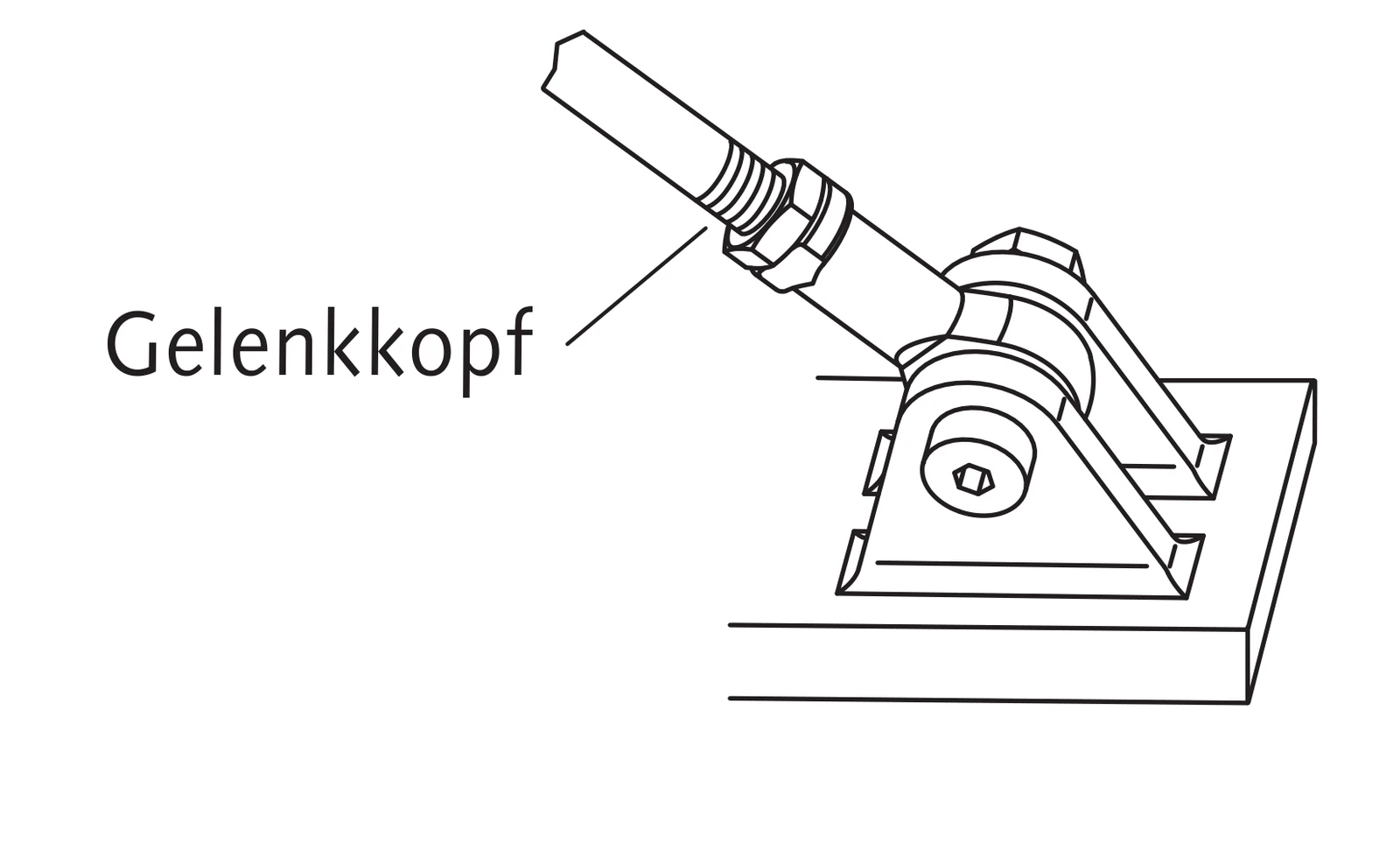
Application example from the Mädler catalogue: after a rod end bearing (Gelenkkopf) is screwed onto a threaded rod, a low hex nut is run up against the shank of the rod end to lock the screwed-in length. Adjustment parts of this kind have a short thread, so a thin nut saves axial lengthSource: Mädler, Niedrige Sechskantmuttern ISO 4035 und ISO 8675, catalogue page K44_N81, Anwendungsbeispiel
Adjuster screws, rod ends, locating pins: Mädler states that the low nut suits short threads and loses the least adjustment travel, and that double-nut locking is particularly favourable with spring plungers (Rastbolzen), locating bushes and rod ends. These positions carry small axial forces and vibration, which is exactly where a thin nut belongs.
Thread length must cover both nuts plus the protrusion: size the threaded section of a stud or adjuster screw from the stacked height in the table above plus the adjustment travel, not from the height of a single nut.
Leave room for the second wrench: the outer nut is usually turned with a socket, so allow side-wall clearance for the socket outside diameter at the square drive d2 (about 22 mm for a 1/2 in. drive), not for the corner width of the nut.
Decide first what the thin nut carriesOnly three cases fit: the inner nut of a double-nut lock; a locking nut for adjustment or location that carries almost no axial load; and a position where a plain nut will not fit axially and the load is well below the stripping load calculated below. Any joint that relies on the nut to build design preload should use a style 1 or style 2 nut.
Size and pitch from the boltUse ISO 4035 for coarse thread and ISO 8675 for fine thread; a left-hand threaded rod takes a left-hand thin nut (Mädler 652 3xx 01 series).
Check the axial loadMultiply the bolt stress before stripping from Würth table 8 by the stress area to get the tension a thin nut can roughly carry, then apply a safety factor.
Fix the double-nut combination and orderThin nut inside, against the part, plain nut outside; the outer nut class follows the bolt (class 8 for class 8.8).
Fix material and lubricationA stainless thin nut on a stainless stud needs lubricant to prevent seizing (Mädler); but double-nut locking performs poorly in joints that require lubrication (Nord-Lock), so where the two conflict consider another locking method.
F_strip ≈ σ_strip × As
F_strip
Bolt tension at which the thin nut starts to strip (strip = thread stripping), N
σ_strip
Bolt stress at that moment (strip = thread stripping), minimum from Würth table 8, MPa (300 for class 04 with a class 8.8 bolt)
Example: M10, class 04 thin nut on a class 8.8 bolt, F_strip ≈ 300 × 58.0 ≈ 17.4 kN. For comparison, Würth chapter 6, table 5 gives a preload of 29.6 kN for a class 8.8 M10 at μ = 0.12 and 90% yield utilisation (see the flange bolt article); a thin nut cannot carry even six tenths of that preload. As comes from chapter 1, table 6 of the Würth catalogue.
1. Fit the thin nut first, against the partPut the thin nut on the side nearest the clamped part and tighten it to 25%~50% of the total torque (Bolt Science). On an adjuster screw, set the position first and then bring the thin nut up against it.
2. Fit the plain nutRun the plain nut down onto the thin nut.
3. Hold the thin nut and tighten the plain nutHold the thin nut still with an open-end wrench and tighten the outer plain nut to the full specified torque. Do not turn the thin nut instead to drive the outer nut.
4. Check and markThe bolt should protrude past the outer nut by at least about two pitches; draw a loosening line across both nuts and the stud so that a walk-round check shows any movement.
Do not put the thin nut on the outside. In the M10 Junker vibration test described by Bolt Science, the arrangement with the thin nut against the part lost only a little preload and showed no clear self-loosening, while with the thin nut outside both nuts turned together and could come off completely.
Do not stack two thin nuts. Bolt Science calls this bad practice: local stripping can occur and the preload is lost.
Do not overtighten the outer nut. Both Nord-Lock and Bolt Science warn that too much force on the second nut can strip the thread or break the bolt between the two nuts.
Lubricate stainless parts. Mädler warns that a stainless nut seizes easily on a stainless stud (cold welding) and must be well lubricated.
The thin nut is used as the load-bearing nut, or the outer nut is tightened with too much torque
Use a style 1 nut on loaded joints; tighten the thin nut to only 25%~50% of total torque
Both nuts turn loose together
The thin nut is on the outside, or the two nuts are not truly wedged
Put the thin nut inside; hold the inner nut and tighten the outer one
Bolt breaks between the two nuts
The outer nut is tightened hard with a long wrench extension
Tighten the outer nut with a torque wrench
Adjustment shifts after a period of running
The thin nut was only hand-tightened against the part and never wedged, plus vibration
Wedge the nuts in the correct order and mark a line; use another locking method where vibration is high
Stainless nut seizes and will not come off
Stainless on stainless assembled dry
Lubricate at assembly or change the material pairing
Wrench slips and rounds the corners
ISO and DIN across flats mixed (M10 16 / 17)
Match the wrench to the actual across flats and state the standard in the BOM
Compiled from Würth chapters 1 and 3, Bolt Science, The Use of Two Nuts to Prevent Self Loosening, the Nord-Lock double nut page and the Mädler catalogue.
Maintenance: double-nut locking loses preload with vibration and embedding, and Nord-Lock states that it needs frequent inspection and maintenance. Check the loosening line on walk-rounds; to relock, slacken the outer nut first and repeat the installation sequence, rather than simply adding force to the outer nut.
08Common design mistakes
Replacing the nut on a loaded joint with a thin nut to save length. A class 04 thin nut on a class 8.8 bolt can strip at a bolt stress of about 300 MPa, less than half the yield point.
Drawing the thread length for one nut only. Double-nut locking needs thread for thin nut + plain nut + protrusion, otherwise the outer nut cannot reach its position or engages only partly.
Drawing the double nut in the wrong order. Mark the thin nut inside and the plain nut outside on the assembly drawing, with the tightening sequence and torque.
No room for an open-end wrench around the inner thin nut. A thin nut against a side wall cannot be held, so assembly relies on hand tightening, which amounts to no lock at all.
ISO thin nut with a DIN plain nut. At M10 and M12 the two nuts differ by 1 mm across flats, so the fitter needs two wrenches and the corners round easily.
Relying on double nuts where lubrication is required and vibration is heavy. Nord-Lock rates the double nut as poor against vibration and especially ineffective when lubricated; use a wedge-locking washer or a positive mechanical stop in such positions.
09Standards and manufacturer ranges
Related standards
Standard
Subject
ISO 4035
Hex thin nut, chamfered (style 0)
ISO 4036
Hex thin nut, unchamfered
ISO 8675
Hex thin nut, fine thread
DIN 439
Hex thin nut (withdrawn, replaced by the three above)
ISO 898-2 / DIN EN 20898-2
Mechanical properties of nuts, including proof stress for classes 04 and 05
GB/T 6172.1, GB/T 6174
National standard hex thin nuts
Current editions apply. The ISO to DIN correspondence comes from Würth chapter 3; the GB numbers are listed in the hex nut article.
Bossard: BN 123, BN 124 and BN 125 (Hex jam nuts ~0,5d, DIN 439 B ~ISO 4035, class 04 steel, plain, blue zinc, yellow zinc and other finishes).
Mädler: ISO 4035 right-hand (652 0xx 01, class 04 zinc plated steel; 652 992 xx, A2-035 stainless steel), ISO 4035 left-hand (652 3xx 01) and ISO 8675 fine thread (652 5xx).
Würth and Fabory: ISO 4035 steel thin nuts in classes 04 and 05, in a range of finishes.
—Sources
Würth DIN catalogue, technical part, chapter 1, Steel fasteners ↗Catalogue page 1752 table 3 (bolt test force, ISO 898-1), 1753 table 5 (yield point at high temperature), 1754 table 6 (nut test force, DIN EN 20898-2, classes 04 and 05), 1755 sections 1.5.1~1.5.2 and table 8 (bolt stress before stripping for thin nuts)
Bolt Science, The Use of Two Nuts to Prevent Self Loosening ↗Arrangement of the double nut (thin nut against the part), tightening order and the 25%~50% torque, Junker vibration test results, the problem with stacked thin nuts, and its reference to ISO 898-2:2012 on thin nuts
Nord-Lock, Bolt securing options: double nut ↗The double nut is a friction locking method; overtightening the second nut strips the thread or breaks the bolt; frequent inspection and maintenance are needed; poor where lubrication is used (a competitor's assessment, of which only the factual points are taken)
Tables and formulas are rearranged from the sources above. Verify against the current standard and the manufacturer catalogue before finalising a design. Updated 2026-11-25
ONLY ON MECHWIKI / SELECT · BUY · MAINTAIN
Buying and using: calculators, sellers, uses
The notes below cover the “Nuts” category. MechWiki prepared these category notes from public standards and engineering references. Use the selected manufacturer’s catalog for ratings, life factors and dimensions.
TOOLS / CALCULATE
Related selection calculators
Use these calculators for a preliminary estimate, then verify the result against this entry, the manufacturer catalogue and installation limits. Results do not replace a specific model rating.
The directory links to manufacturer selection and CAD resources and identifies the maker of the pictured example. Check stock and lead time with the supplier. Price comparison and ranking are not available yet.
MISUMIFactory automation and tooling components with selection and CAD resources.