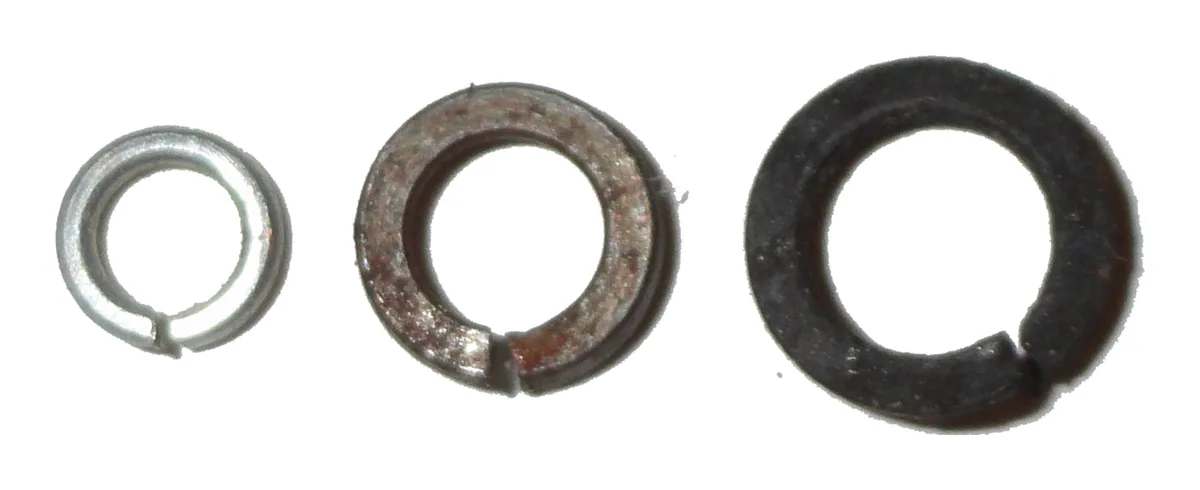
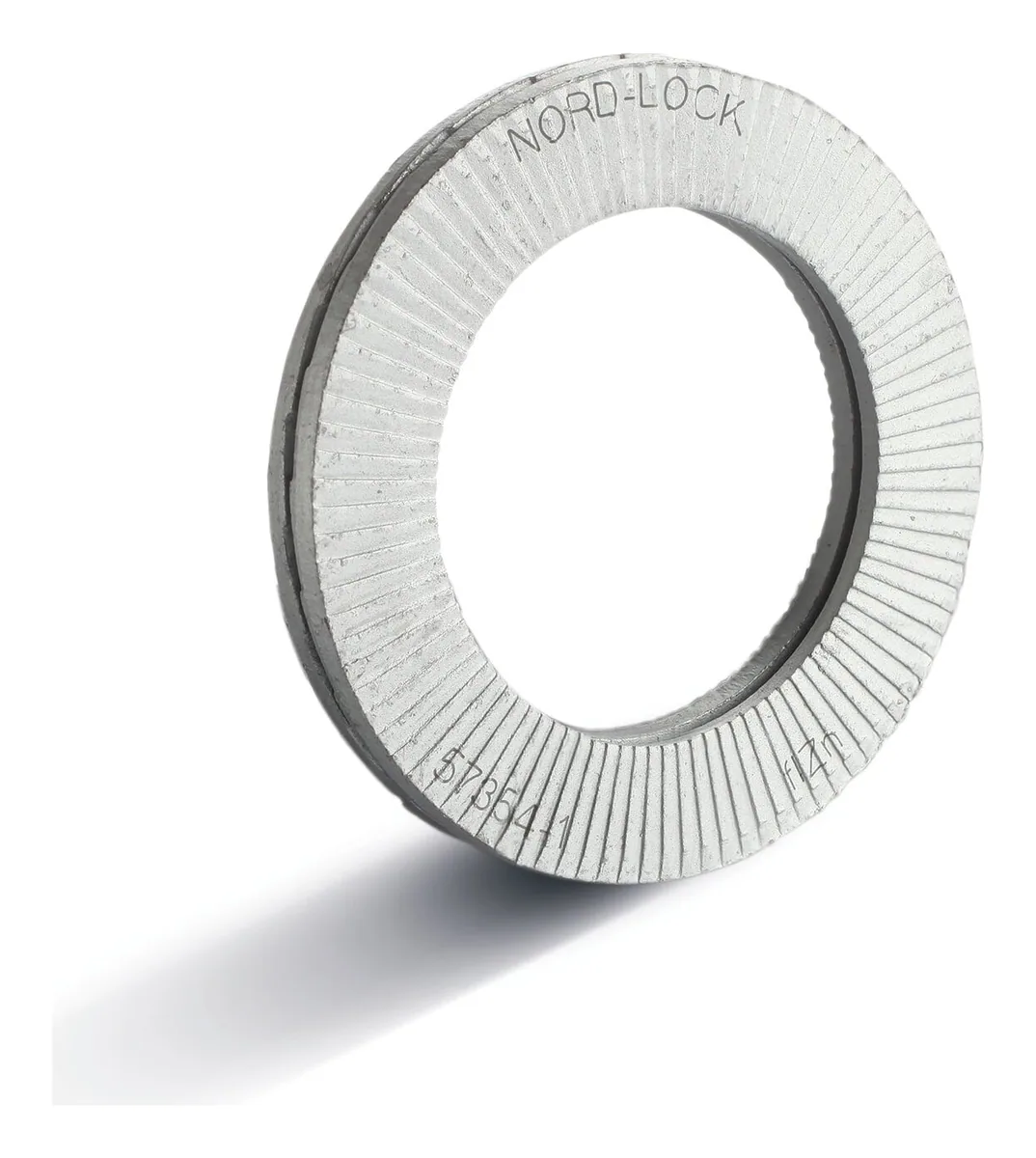
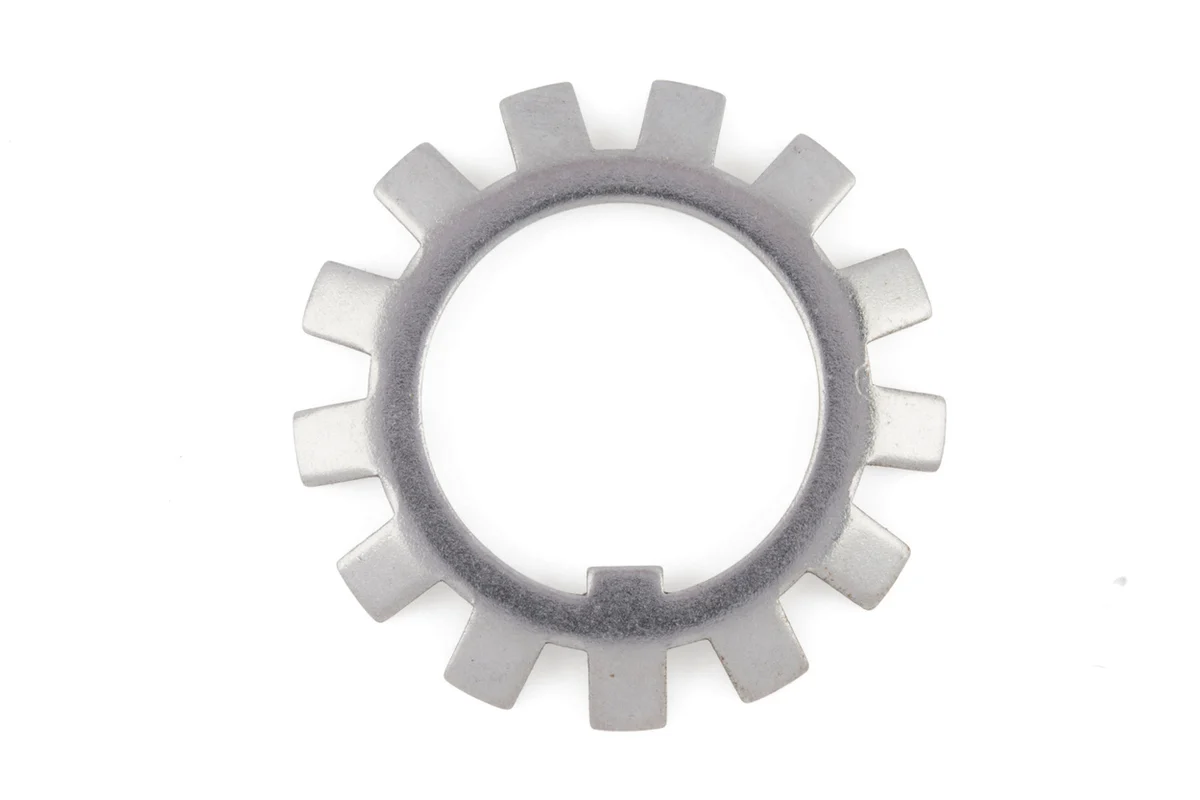
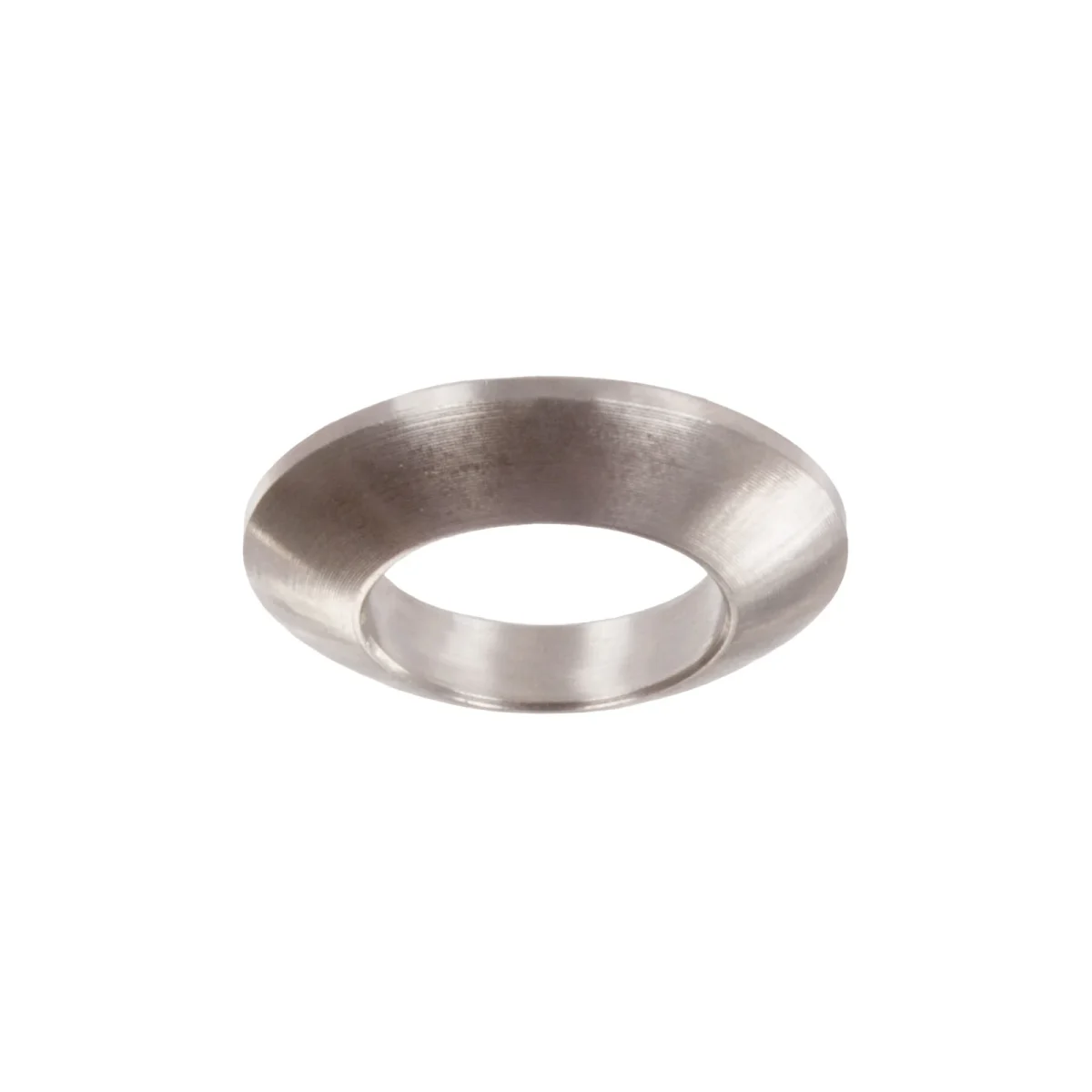
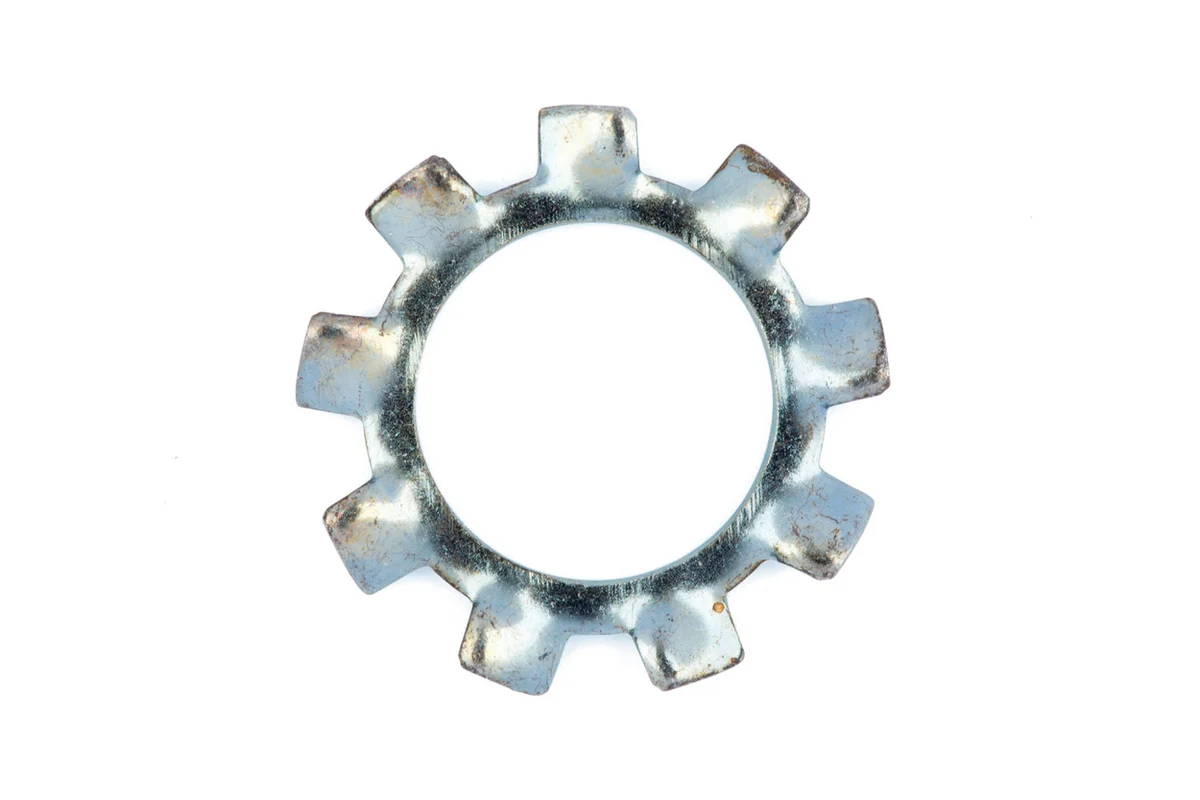
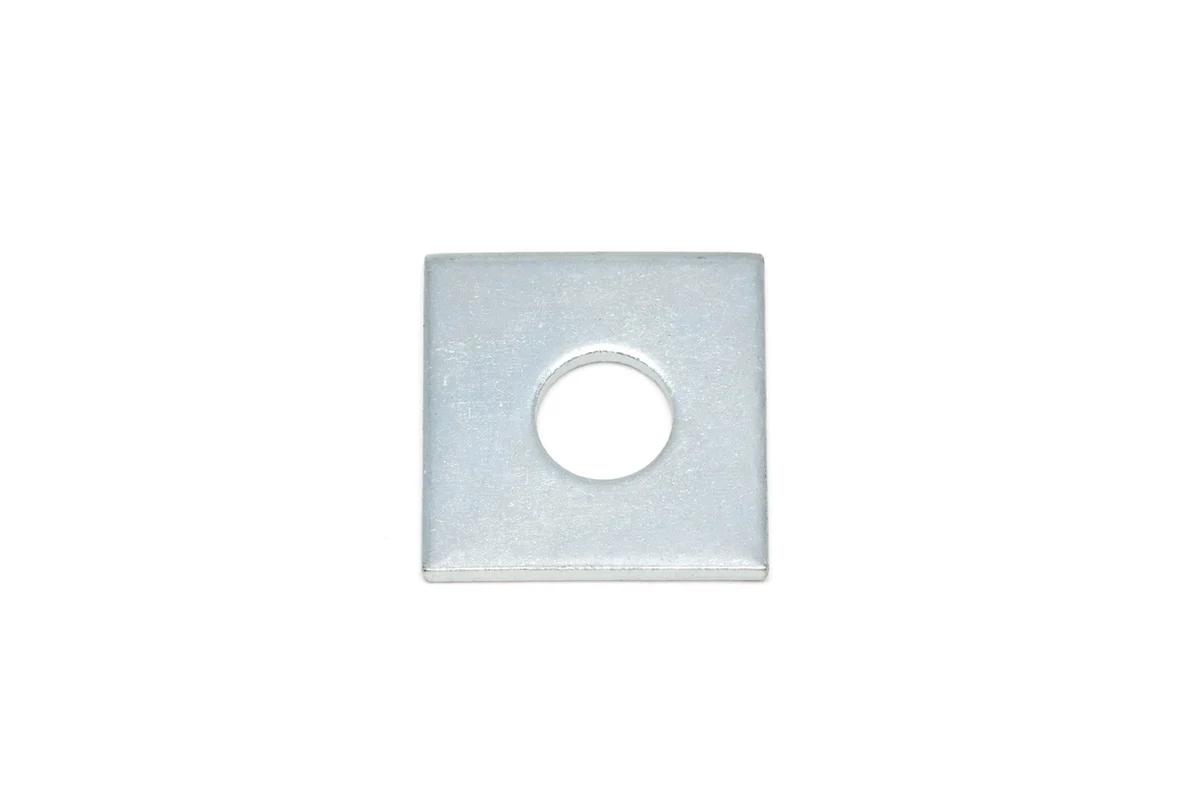
Product illustration · Wikimedia CommonsPictured model: Model not specifiedOriginal source Spring lock washers · example · Андрей Перцев · Wikimedia Commons · CC0 · Cropped and resized · Image licence
01 / INTRODUCTION
What is it?
A split, helically formed spring washer placed under a nut or screw head. It reduces loosening through the spring force of the flattened washer and the bite of the split ends.
02 / CONSTRUCTION
Construction & recognition
Made from rectangular-section wire or strip, formed with a gap and heat treated. Tightening flattens it and generates axial spring force. The split ends bear on the bearing surface and on the nut and resist back rotation.
03 / APPLICATIONS
Common applications
Threaded joints with low preload in general machinery, electrical terminals, and positions where a high preload cannot be applied.
Image copyright belongs to the manufacturers or original authors. Brands and models identify illustrations; consult official documentation when selecting parts.
ENGINEERING GUIDE
Selection and design guide
A split elastic washer twisted into a helix and flattened as the joint is tightened; it resists loosening through spring-back and through the split ends bearing on the seating face. The GB/T 93 standard type is the most common, sized by the thread major diameter. It is cheap and easy to fit, but vibration tests show that it cannot stop self-rotation under transverse vibration, so it is used only on unimportant joints with low preload; critical bolts in vibrating equipment should switch to a wedge-locking washer, a lock nut or a similar method.
01Construction and how it works
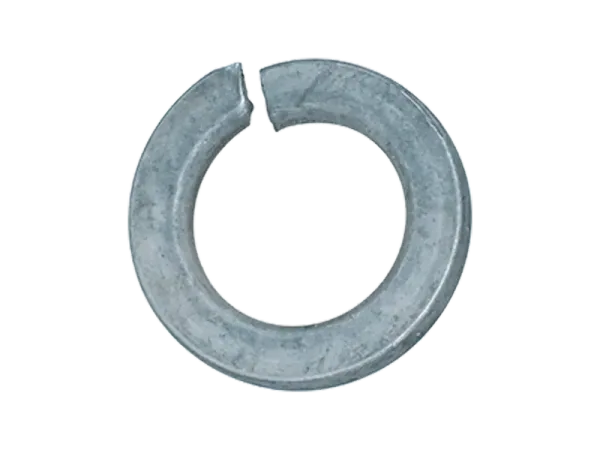
A spring washer is made from rectangular-section spring steel, split, twisted into a helix and then heat treated. In the free state the two split ends are offset one above the other, and they are pressed flat when the nut or screw is tightened. The Machine Design Handbook groups it under fastening by increased friction: the axial spring force produced by flattening, plus friction between the washer and the seating face, resists loosening. The construction is simple, the cost is low and fitting is easy, but the force is uneven and reliability is poor. It is used mostly on less important joints, and it must not be used where the clamped part may not be scratched, or on joints that are taken apart often.
Bossard BN 20430 split spring lock washer with flat ends (matching the withdrawn DIN 127 B), spring steel, zinc plated blue passivated. The two ends at the split are visibly offset and are pressed flat on tighteningSource: Bossard online shop product page, BN 20430 Split spring lock washers with flat end
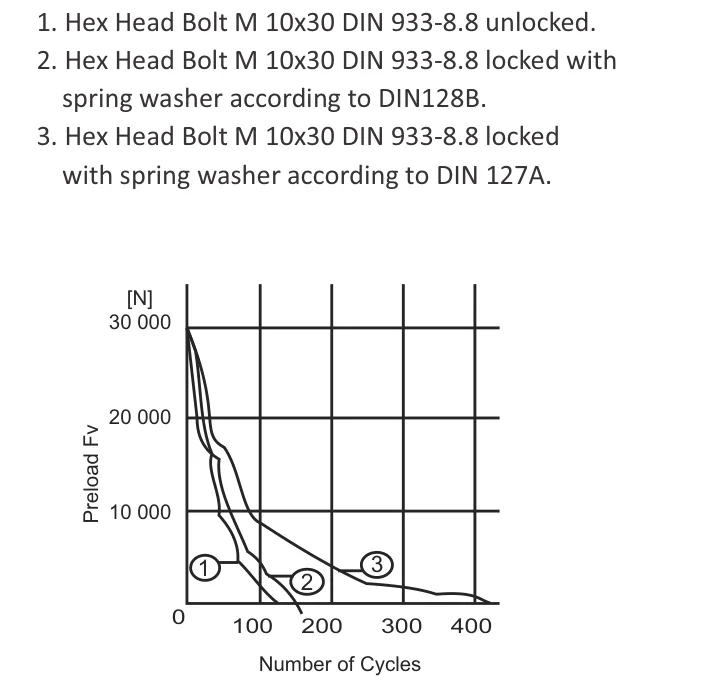
The limitation shows clearly in vibration tests. In the transverse vibration test quoted by the Unbrako catalogue (M10×30 DIN 933 class 8.8 hex head bolt, initial preload about 30 kN), the preload of a bolt with no locking device and of bolts with two kinds of spring washer all dropped to zero within a few hundred cycles. The conclusion of the catalogue is that a spring washer has no real self-locking ability.
Preload against number of cycles in the transverse vibration test. The vertical axis is preload Fv (N) and the horizontal axis is the number of cycles. 1: M10×30 DIN 933 class 8.8 hex head bolt, no locking device; 2: the same bolt with a DIN 128 B spring washer; 3: the same bolt with a DIN 127 A spring washer. All three curves fall to zero within about 100~400 cyclesSource: Unbrako, Unbrako US Product Guide
02Types and designation systems
Spring washers and similar elastic washers
Type
Standard
Features
Standard spring washer
GB/T 93
Most common; the section is close to square
Light spring washer
GB/T 859
Flat and wide section (b greater than S); lower spring force
Heavy spring washer
GB/T 7244
Thicker section; sizes start at M6
Curved and wave spring washers
GB/T 7245, GB/T 7246
The handbook states that they clearly improve on the shortcomings of an ordinary spring washer
Flat-end / upturned-end spring washer (German standard)
DIN 127 B / A (withdrawn)
Bossard still supplies it, but recommends the DIN 128 A curved spring washer for new designs
The GB numbers are taken from the Machine Design Handbook, part 6, chapter 1, Table 6-1-57 (printed page 6-61) and Table 6-1-165 (printed page 6-158); the handbook quotes the 1987 edition, so the current edition applies. The status of DIN 127 and the Bossard recommendation come from the Bossard BN 20430 product page.
A spring washer affects the layout in two main ways: the free height H and the flattened thickness S must be counted into the bolt length, and the outside diameter must fall inside the seating face; where the washer sits in a counterbore, the counterbore diameter must be large enough to take it. The table below gives the GB dimensions.
Standard and light spring washer dimensions (GB/T 93, GB/T 859, mm)
Size
Inside diameter d min
Standard type S=b
Standard type H max
Standard type m ≤
Light type S × b
Light type H max
3
3.1
0.8
2
0.4
0.6 × 1
1.5
4
4.1
1.1
2.75
0.55
0.8 × 1.2
2
5
5.1
1.3
3.25
0.65
1.1 × 1.5
2.75
6
6.1
1.6
4
0.8
1.3 × 2
3.25
8
8.1
2.1
5.25
1.05
1.6 × 2.5
4
10
10.2
2.6
6.5
1.3
2 × 3
5
12
12.2
3.1
7.75
1.55
2.5 × 3.5
6.25
16
16.2
4.1
10.25
2.05
3.2 × 4.5
8
20
20.2
5
12.5
2.5
4 × 5.5
10
24
24.5
6
15
3
5 × 7
12.5
30
30.5
7.5
18.75
3.75
6 × 9
15
From the Machine Design Handbook, part 6, chapter 1, section 3.7.6, Table 6-1-165 (printed page 6-158, taken from GB/T 93—1987 and GB/T 859—1987). The size is the thread major diameter; S is the section thickness, b the section width (S and b are equal on the standard type), H the free height and m the offset of the two ends at the split, which the standard requires to be greater than zero. The original table also lists M2~M48 and non-preferred sizes in brackets.
Bolt length: count the flattened thickness S into the grip length, then use the free height H to confirm that the thread can still be started at assembly.
Seating face: the split ends leave scratches on the seating face, so painted, plated and machined faces should not be in direct contact with the washer.
Wrench space: the same as for an ordinary bolted joint.
Equal to the thread major diameter; an M10 bolt takes size 10
GB/T 93 designation example
Type
Standard, light, heavy
GB/T 93, 859, 7244
Material
65Mn is the most common; other technical conditions follow GB/T 94.1
Handbook Table 6-1-165, note 1
Surface finish
Oxide (black), zinc plated and others
The designation example is oxide finish
Hydrogen embrittlement risk
Fasteners with a quenched and tempered hardness of ≥ 360 HV are prone to hydrogen embrittlement after electroplating
Bossard product page, citing ISO 4042
Designation example: a standard spring washer of size 16, material 65Mn and oxide finish is designated Washer GB/T 93 16.
05Selection and calculation
Decide first whether it can be usedThe handbook places it among the less important joints. Where a bolt sees strong vibration, alternating transverse force or a high preload, do not rely on a spring washer: use a wedge-locking washer, a lock nut, thread adhesive or a mechanical stop.
Rule out the forbidden casesDo not use it where the clamped surface must not be scratched, or where the joint is taken apart often.
Choose type and sizeTake the size from the thread major diameter and normally use the GB/T 93 standard type; a small screw with little space and low preload can take the GB/T 859 light type.
Set material and finishWatch hydrogen embrittlement on zinc plated parts and confirm de-embrittlement with the supplier; choose stainless steel in a corrosive environment.
A spring washer has no design calculation; selection is a table look-up against the bolt size. It does not raise the locking grade of a joint: what really decides whether a bolt rotates loose is whether the preload is sufficient and whether the clamped parts slide against each other.
Fit the washer on the side that turns (under the nut or under the screw head) and tighten until the washer is completely flat.
The split ends scratch the seating face, so do not let them touch painted or machined surfaces.
A removed spring washer has lost spring force and has blunt split ends; fit a new one when the joint is reassembled.
07Failure modes and maintenance
Common problems, causes and actions
Symptom
Main cause
Action
Bolt works loose under vibration
A spring washer cannot stop self-rotation under transverse vibration
Use a wedge-locking washer, a lock nut or thread adhesive; raise the preload
Washer fractures
Brittle fracture of a hardened part, or hydrogen embrittlement after plating
Buy from a reliable supplier and confirm de-embrittlement
Seating face scratched, coating damaged
The split ends scrape the surface
Use another locking method on such surfaces
Washer will not flatten or sits skewed
Tilted seating face, or too large a chamfer at the hole
Machine the seating face; check the counterbore against the outside diameter
Row 1 follows the vibration test conclusion on page 99 of the Unbrako catalogue; row 2 the hydrogen embrittlement note on the Bossard product page; row 3 Table 6-1-57 of the Machine Design Handbook.
08Common design mistakes
Treating it as a locking device for vibrating joints. The test curves show that a class 8.8 M10 bolt with a spring washer loses its preload within a few hundred vibration cycles, exactly as one without.
Using it on painted surfaces or machined aluminium parts. The split ends scratch the surface.
Leaving the washer out of the bolt length. The M10 standard type is 6.5 mm high free and 2.6 mm once flattened.
Copying DIN 127 into a new design. That standard is withdrawn and Bossard recommends DIN 128 A for new designs; in China use the current GB/T 93.
09Standards and manufacturer ranges
Related standards
Standard
Subject
GB/T 93
Standard spring washer
GB/T 859
Light spring washer
GB/T 7244
Heavy spring washer
GB/T 94.1
Technical conditions for elastic washers (spring washers)
DIN 127
Spring washer (German standard, withdrawn)
DIN 128
Curved and wave spring washers (German standard)
ISO 4042
Electroplated coatings on fasteners (with a hydrogen embrittlement note)
The GB numbers come from Table 6-1-165 and its notes in the Machine Design Handbook (the 1987 edition is quoted, so the current edition applies); DIN 127, DIN 128 and ISO 4042 come from the Bossard BN 20430 product page.
Bossard: BN 20430 split spring lock washer with flat ends (DIN 127 B), spring steel zinc plated blue passivated; mechanical zinc, hot dip galvanized and inch sizes are also available.
Chinese standard parts are supplied to GB/T 93 and GB/T 859, commonly in 65Mn black oxide, zinc plated and stainless steel.
—Sources
Machine Design Handbook, part 6 Connections and fastening, chapter 1 Threads and threaded jointsSection 3.2, Table 6-1-57, common locking methods for threaded joints (printed page 6-61); section 3.7.6, Table 6-1-165, standard, light and heavy spring washers (GB/T 93—1987, GB/T 859—1987, GB/T 7244—1987, printed page 6-158)
Unbrako, Unbrako US Product Guide ↗Page 99, How can the self-locking ability be evaluated: transverse vibration test curves (M10×30 DIN 933 8.8, no locking device, DIN 128 B and DIN 127 A spring washers) and the conclusion
Tables and formulas are rearranged from the sources above. Verify against the current standard and the manufacturer catalogue before finalising a design. Updated 2026-11-20
ONLY ON MECHWIKI / SELECT · BUY · MAINTAIN
Buying and using: calculators, sellers, uses
The notes below cover the “Washers” category. MechWiki prepared these category notes from public standards and engineering references. Use the selected manufacturer’s catalog for ratings, life factors and dimensions.
TOOLS / CALCULATE
Related selection calculators
Use these calculators for a preliminary estimate, then verify the result against this entry, the manufacturer catalogue and installation limits. Results do not replace a specific model rating.
The directory links to manufacturer selection and CAD resources and identifies the maker of the pictured example. Check stock and lead time with the supplier. Price comparison and ranking are not available yet.
MISUMIFactory automation and tooling components with selection and CAD resources.