What is it?
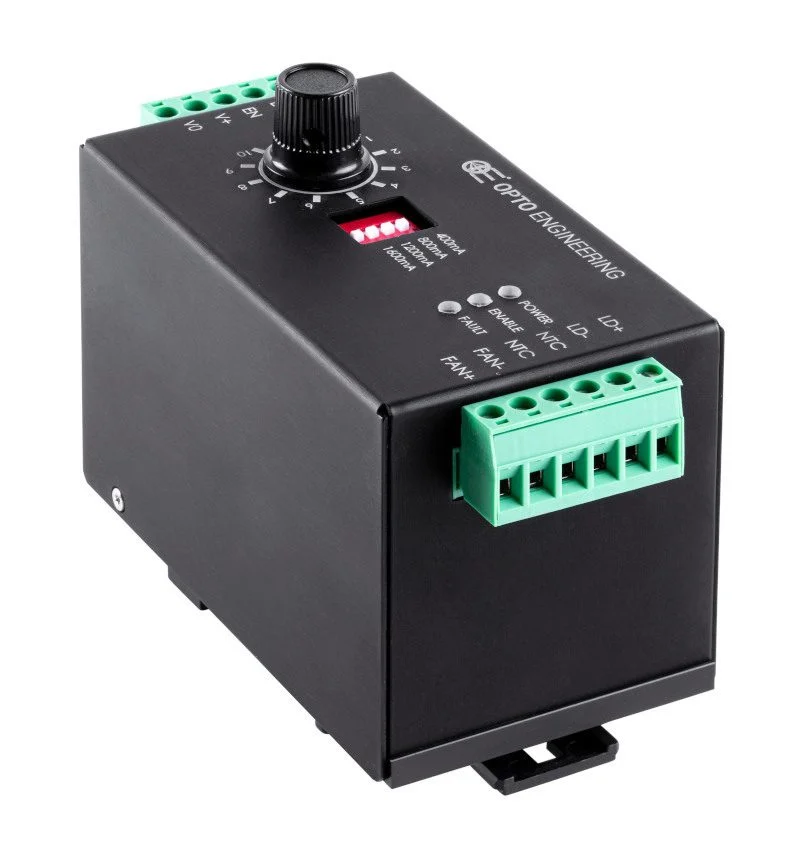
A driver that powers a vision light and controls brightness, on/off and strobing. It accepts a trigger signal from a camera or a PLC and can light the lamp only at the instant of exposure.
Construction & recognition
One or more output channels drive the LEDs at constant voltage or constant current, and brightness is set by knob, key, DIP switch or communication (RS-232, Ethernet). A strobe type outputs a pulse synchronized with the exposure on an external trigger; an overdrive type can run the LED briefly at a current far above the rating for higher brightness, but pulse width and duty cycle must be limited or the LED will be destroyed. The Opto Engineering LTIC series is a light intensity controller used as an accessory to its lights for precise brightness adjustment. Selection covers channel count, voltage and current per channel including strobe peak current, trigger mode and response time, dimming method, communication interface and supply.
Common applications
Powering lights at vision inspection stations, brightness adjustment and strobe synchronization, time-shared lighting of several lights, and remote brightness switching by product recipe.