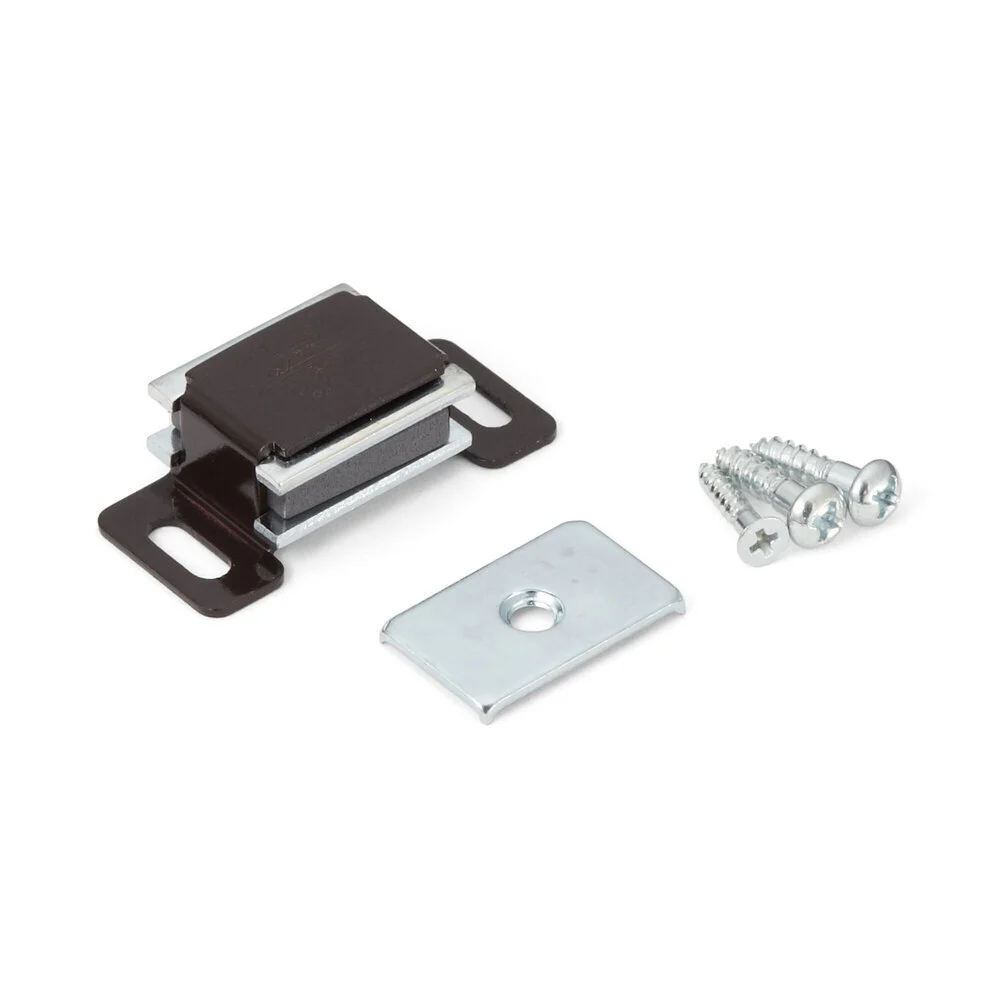
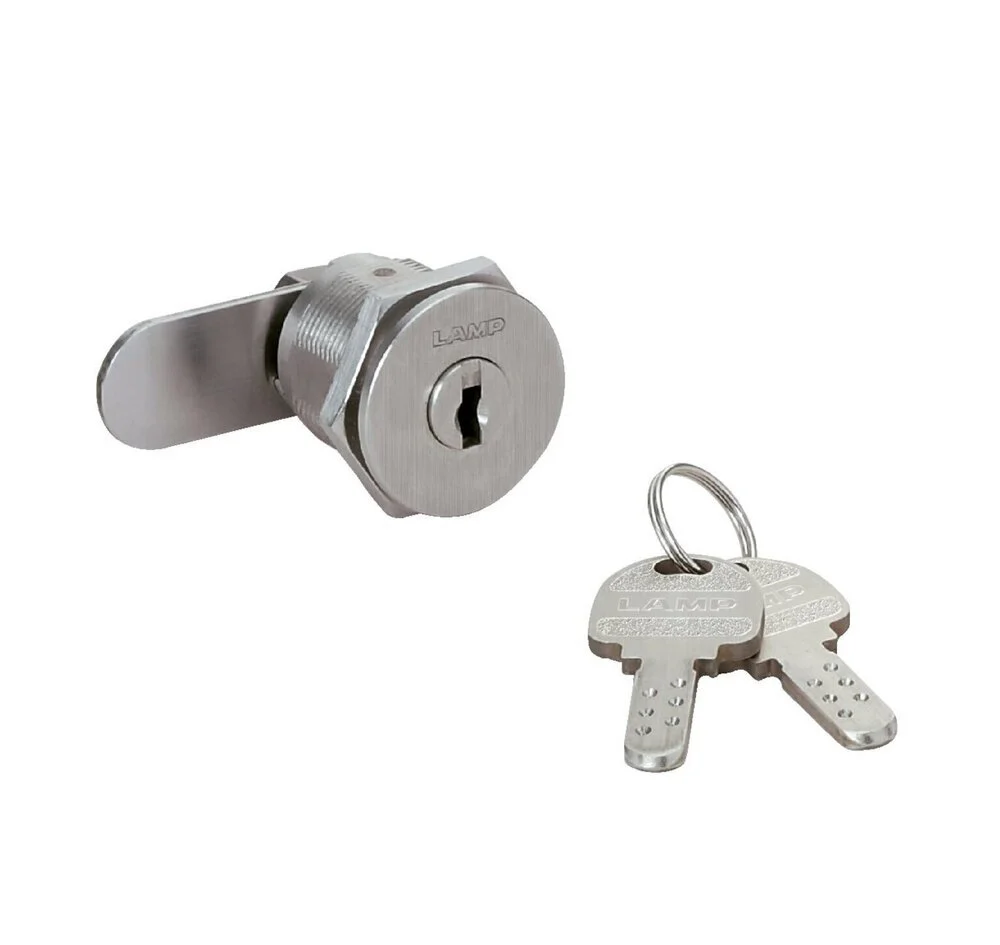
Image copyright belongs to the manufacturers or original authors. Brands and models identify illustrations; consult official documentation when selecting parts.
ENGINEERING GUIDE
Selection and design guide
A door magnet (magnetic catch) uses a permanent magnet to hold a steel plate on the door, keeping small doors, flaps and sliding doors closed until a hand pulls them open. Take the Elesa+Ganter GN 4470 as an example: it has a neodymium-iron-boron magnet with a rubber coating, a nominal holding force of 30 N, M5 screw fixing, versions with slots for position adjustment, and a magnet rated to 80 °C. Holding force is very sensitive to the air gap. From the Elesa+Ganter curve, only about 67 % remains at a 0.1 mm gap, about 42 % at 0.2 mm and about 10 % at 0.6 mm. The nominal value is measured on 10 mm thick mild steel, with full-face contact and a vertical pull-off. A door magnet only holds a door closed; it cannot replace a lock or a safety interlock.
01Construction and how it works
A door magnet has two parts: the magnet base fitted to the door frame or cabinet, and the striking plate (the steel piece) fitted to the door. When the door closes, the plate meets the magnet face, the magnetic flux closes through the plate, and the resulting holding force keeps the door shut. Once the pull on the door exceeds the holding force, the door opens. No power is needed and there are no moving parts.
The Elesa+Ganter technical data sets out several factors that affect holding force:
Test conditions for the nominal holding force: room temperature; full-face contact between magnet and workpiece; vertical pull-off; a workpiece of mild steel at least 10 mm thick. The nominal value in the catalogue table is the minimum under these conditions.
Air gap: air or non-magnetic material between the magnet and the workpiece weakens the flux, and holding force falls as the distance grows.
Workpiece thickness: the workpiece must be thick enough. If it is too thin, the flux cannot pass through and holding force drops.
Workpiece material: mild steel and unhardened steel conduct flux well; hardened steel conducts it poorly.
Surface: a rough or uneven surface is the same as adding an air gap.
Lateral (sliding) force: this equals the friction force and depends on the holding force and the coefficient of friction. A rubber-coated magnet has a high coefficient, so the lateral force is high too.
Comparison of magnet materials (Elesa+Ganter technical data)
Item
Hard ferrite
Alnico
Samarium cobalt
Neodymium-iron-boron
Holding force
Strong
Medium
Strong
Very strong
Maximum working temperature (reference)
approx. 200 °C
approx. 450 °C
approx. 200 °C
approx. 80 °C
Holding force after heating
Falls
Stays good
Falls
Falls
Corrosion resistance
Very good
Very good
Good
Good after nickel plating
Mechanical properties
Very hard, brittle
Very hard, tough
Very hard, brittle
Very hard, brittle
Price
Very low
High
Very high
Reasonable
From the material comparison table on the Elesa+Ganter technical data page 'Retaining magnets / Raw magnets'. The maker notes that the maximum temperature is only a reference and also depends on magnet size. Door magnets mostly use neodymium-iron-boron, which is small and strong but sensitive to heat, so it is not suitable for doors near ovens or heaters.
An electromagnet, which holds only while energised, and an electro-permanent magnet, which switches with power on and off, are separate parts. Their behaviour when power fails differs from that of a permanent-magnet door magnet.Holding Electromagnet →Electro-Permanent Magnetic Chuck →
02Types and designation systems
Versions of the GN 4470 magnetic catch
Code
Meaning
A1
Magnet face on top, round-hole mounting
A2
Magnet face on top, slotted mounting (position adjustable)
C1
Magnet face on the side, round-hole mounting
C2
Magnet face on the side, slotted mounting (position adjustable)
W
Without a striking plate
F
With a flat striking plate, countersunk hole (DIN 7991-M4)
L2 / L3
With an L-shaped striking plate and slots; L3 has longer slots
Z2 / Z3
With a Z-shaped striking plate and slots; Z3 has longer slots
From page 1 of Elesa+Ganter GN 4470 Magnetic catches (10/2020). The body is die-cast zinc with a powder coating (black RAL 9005 or silver RAL 9006). The NdFeB magnet is rated to 80 °C, the magnet face is covered in TPE rubber (approx. 80 Shore A), and the striking plate is zinc-plated steel.
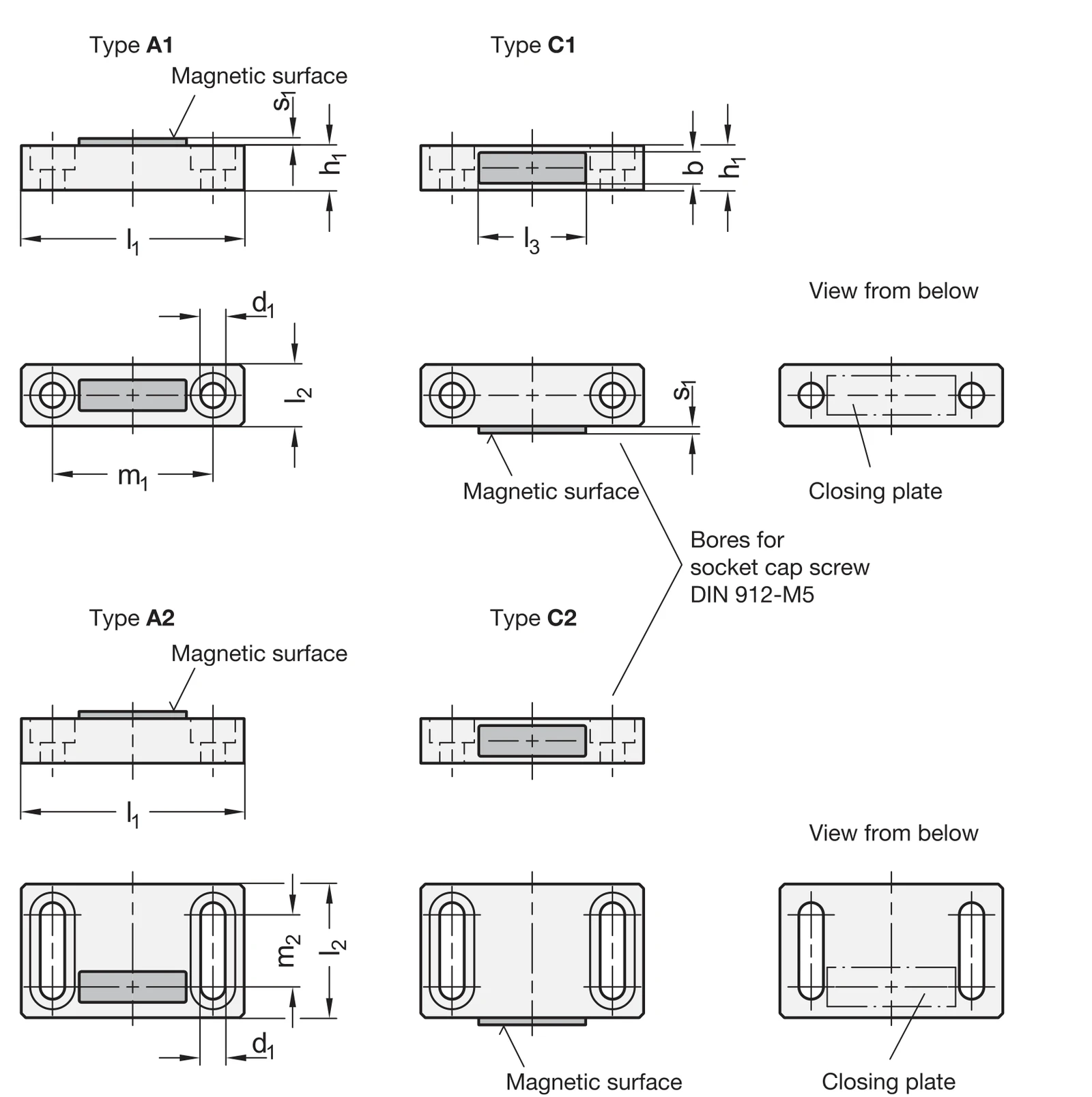
Four versions of the GN 4470 magnetic catch. On A1 and A2 the magnetic surface is on top; on C1 and C2 it is on the side. A1 and C1 use round holes; A2 and C2 use slots. l1 is length, h1 height, l2 width, m1/m2 hole pitch, d1 hole diameter and s1 magnet-face projection. Closing plate in the underside view is the bottom cover. The mounting holes take DIN 912-M5 socket head cap screws.Source: Elesa+Ganter, GN 4470 Magnetic catches, page 1 (ELESA and GANTER models all rights reserved)
Comparison with other parts that hold a door closed: the ball catch (Elesa+Ganter GN 4490) uses a spring to push a steel ball into a detent. Its holding force runs from 25 to 150 N by size and is unaffected by air gaps or the striking-plate material, but it wears. A door magnet has no wearing parts and closes quietly, but its holding force falls quickly as the gap grows. Use a lock to prevent accidental opening; use a safety door switch to prevent someone opening a guard door while the machine is moving.
Holding force of the GN 4490 ball catch (for comparison)
Size (length l1)
Standard type A1 / B1
Heavy-duty type A2 / B2
38 mm
25 N
35 N
50 mm
40 N
70 N
68 mm
75 N
100 N
80 mm
125 N
150 N
From page 2 of Elesa+Ganter GN 4490 Ball Catches (9/2026). FH in the table is the holding force.
03Key parameters
Nominal holding force: every GN 4470 version is 30 N (catalogue table). This is the minimum with full-face contact. On a real door with a gap and a thin striking plate, the force is much lower.
Magnet material and temperature rating: NdFeB, approx. 80 °C.
Mounting screws and holes: the GN 4470 body uses DIN 912-M5, with a 5.5 mm hole. The type F striking plate uses a DIN 7991-M4 countersunk screw.
Adjustment: the slotted types (A2, C2) and the L and Z striking plates with slots allow position adjustment. On aluminium profiles, the door-gap adjustment range s for the Z and L plates runs from 0 to 7 mm up to 0 to 15 mm, depending on the profile size.
Magnet-face construction: the GN 4470 magnet face is rubber-coated, which reduces closing noise, protects the mating part and increases lateral friction.
Main dimensions and holding force of the GN 4470 (mm)
Model
Length l1
Height h1
Width l2
m1 / m2
Hole diameter d1
Holding force N
Weight g
GN 4470-50-A1-W
50
10
12
38
5.5
30
29
GN 4470-50-A2-W
50
10
30
18 (slot)
5.5
30
54
GN 4470-50-C1-W
50
10
12
38
5.5
30
29
GN 4470-50-C2-W
50
10
30
18 (slot)
5.5
30
54
GN 4470-50-A1-F (with flat striking plate)
50
10
12
38
5.5
30
35
GN 4470-50-A2-Z3 (with Z striking plate)
50
10
30
18 (slot)
5.5
30
77
From the dimension table on page 2 of Elesa+Ganter GN 4470 Magnetic catches. m1 is the centre distance between the two round holes, and m2 is the dimension along the slot on slotted versions (see the figure above). The magnet-face projection s1 is 0.5 mm. The flat striking plate F is 2.5 mm thick, and the L and Z plates are 2 mm thick.
Holding force falling with air gap (read from the Elesa+Ganter curve)
Air gap mm
0
0.1
0.2
0.3
0.4
0.6
Remaining holding force (share of full-face value)
100 %
approx. 67 %
approx. 42 %
approx. 28 %
approx. 18 %
approx. 10 %
Read from the Air gap curve on the Elesa+Ganter technical data page 'Retaining magnets / Raw magnets'. It is a general illustration, not a curve specific to the GN 4470. All values are read from the graph and are approximate.
04Dimensions, interfaces and installation space
Take the Elesa+Ganter GN 4470-50 as an example. The body is 50 × 12 × 10 mm (A1/C1) or 50 × 30 × 10 mm (A2/C2, slotted). It is fixed with two M5 socket head screws, with a 38 mm centre distance between the round holes. The magnet face projects 0.5 mm beyond the body. The top-face type (A) mounts on the front of the door frame, and the door face meets it. The side-face type (C) mounts on the side, which suits a door closing from the side or a sliding door.
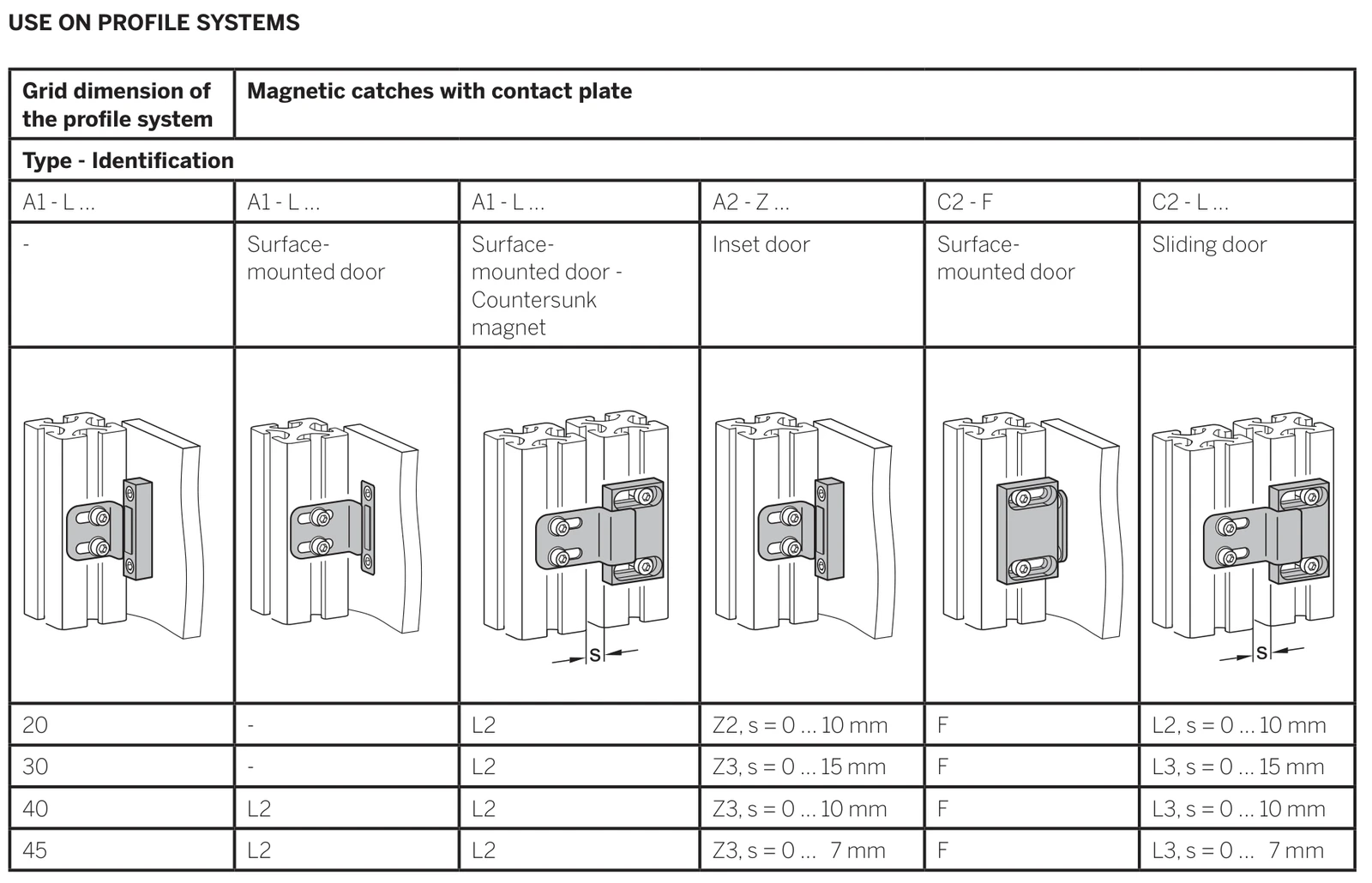
Use of the GN 4470 on aluminium profile frames, with striking-plate combinations. The headings, from left to right, are A1-L, A1-L surface-mounted door, A1-L surface-mounted door with a countersunk magnet, A2-Z inset door, C2-F surface-mounted door, and C2-L sliding door. The table below gives the available striking plates (L2, L3, Z2, Z3, F) and the door-gap adjustment range s for profile sizes 20, 30, 40 and 45.Source: Elesa+Ganter, GN 4470 Magnetic catches, page 3
Striking-plate selection for profile frames (GN 4470)
Profile size
Surface-mounted door A1-L
Surface-mounted door, countersunk magnet A1-L
Inset door A2-Z
Surface-mounted door C2-F
Sliding door C2-L
20
—
L2
Z2, s = 0~10 mm
F
L2, s = 0~10 mm
30
—
L2
Z3, s = 0~15 mm
F
L3, s = 0~15 mm
40
L2
L2
Z3, s = 0~10 mm
F
L3, s = 0~10 mm
45
L2
L2
Z3, s = 0~7 mm
F
L3, s = 0~7 mm
From page 3, 'Use on profile systems', of Elesa+Ganter GN 4470 Magnetic catches. A dash means the catalogue gives no combination for that profile size. s is the door-gap adjustment range marked in the figure.
When the door is aluminium, stainless steel or plastic: the door itself cannot be held magnetically, so fit a steel striking plate. Elesa+Ganter states that the striking-plate assemblies are provided for exactly this case, where the mating part is non-magnetic.
Type A needs full-face contact: the maker requires A1 and A2 types to sit flat over the whole striking-plate area. If the plate is slightly crooked or does not lie flat, the air-gap curve shows a large drop in holding force.
Position: fit the magnet on the free edge of the door, far from the hinges, so the same holding force resists a larger opening moment. Do not place it directly behind the handle, because pulling the handle opens that corner first and twists the door.
End stop: a door magnet is not a stop. If the door springs back or the seal pushes back, add a separate stop or buffer, and do not let the magnet take the closing impact.
Temperature: on doors near heaters or ovens, neodymium-iron-boron demagnetises above 80 °C, so choose another material or switch to a mechanical catch.
1 Estimate the force to resistThe tendency of the door to open under its own weight (a door leaning outwards or a sloped flap), the rebound force of the seal or buffer, machine vibration and wind.
2 Estimate the actual gapThe real gap between the striking plate and the magnet face once the door is shut. Plate flatness, coating thickness, door warp and hinge sag all add to the air gap.
3 Derate the holding forceUse the air-gap curve to discount the nominal holding force, then compare it with the force from step 1 and leave margin. If it is not enough, add a second door magnet or switch to a ball catch or a lock.
4 Check the opening forceToo much holding force makes the door hard to open and can deform a thin door panel. A door magnet is for holding, not for locking.
5 Choose the mounting arrangementOn profile frames, select the striking plate from the table above. Where the door gap must be adjusted on site, choose a slotted type (A2, C2) or an L or Z striking plate. A non-magnetic door must have a striking plate.
F_eff = F_nom × k(δ) ≥ S × F_open
F_eff
Effective holding force, N
F_nom
Nominal catalogue holding force, N (30 N for the GN 4470)
k
Coefficient read from the curve at the actual air gap δ (approx. 0.67 at 0.1 mm, approx. 0.42 at 0.2 mm)
δ
Air gap between the magnet face and the striking plate, mm
F_open
Opening force to resist at the door magnet position, N
S
Safety factor, chosen by the designer
k(δ) comes from the general Elesa+Ganter curve and is for estimation only. Discount it further when the striking plate is thin or is not made of mild steel. The most reliable check is to measure the pull-off force on a sample.
06Installation, adjustment and use
1 Fit the magnet base firstFix it to the door frame or profile with M5 socket head screws at the positions on the drawing. On slotted types, leave the screws loose at first.
2 Fit the striking plateClose the door and check that the plate lines up with the magnet face. On type A, the whole striking-plate area must sit flat.
3 AdjustUse the slots to move the magnet base or the striking plate until the plate meets the magnet face exactly when the door is closed, and the door gap s meets the requirement. Then tighten the screws.
4 Test opening and closingOpen and close the door a few times. It should latch naturally without springing back, open without effort, and leave the door untwisted.
Keep the magnet face clean: a magnet attracts iron filings. Near machining areas, clean the magnet face and striking plate regularly, because filings caught between them act as an air gap.
Do not use the magnet base as a door stop: repeated closing impacts on the magnet damage the rubber face and the magnet. Fit a separate buffer.
Coatings: a thick coating on the striking plate is also an air gap. Choose a zinc-plated plate or a thin coating.
07Failure modes and maintenance
Common problems, causes and actions
Symptom
Likely cause
Action
The door does not stay shut and springs open
The gap has grown (hinge sag, door warp, loose striking plate); the seal pushes back hard
Readjust the striking plate and hinges; add a door magnet or switch to a ball catch
Holding force drops noticeably
Iron filings or grime between the magnet face and plate; the plate was replaced with a non-magnetic material; heat demagnetisation
Clean it; use a mild-steel striking plate; move away from heat or choose a temperature-resistant material
The door is hard to open and the panel deforms
Holding force too high, or the magnet is placed too far from the handle
Choose a lower-force model; move it
The rubber magnet face is damaged
Closing impacts; the magnet is also used as a stop
Add a buffer stop; replace
The striking plate corrodes
Damp environment with damaged plating
Use the special striking plate for stainless frames or apply fresh corrosion protection
Compiled from Elesa+Ganter data and practical experience.
08Common design mistakes
Using the nominal holding force directly: the nominal value is measured on 10 mm mild steel with full-face contact. A 0.2 mm gap on the door leaves only about 40 %.
No striking plate on an aluminium or stainless door: austenitic stainless steel, aluminium and plastic cannot be held magnetically.
Treating a door magnet as a lock: anyone can pull it open, and a guard door pulled open during machine movement is not detected at all. To prevent opening during movement, use a safety door switch or an interlock with a locking function.
Using the door magnet as a stop: closing impacts hit the magnet and quickly damage the face.
Placing it near a heat source: neodymium-iron-boron starts to be affected at about 80 °C.
One magnet for a large door: a large or wide door with only one magnet lifts at the other corner, opening a larger gap and holding less and less.
There is no dedicated product standard for door magnets. Makers give nominal holding force under their own test conditions (Elesa+Ganter: room temperature, full-face contact, vertical pull-off, mild steel at least 10 mm thick). Where a guard door must not open during movement, design the interlock to the relevant machine-safety standards, such as ISO 14119 for interlocking devices. A door magnet cannot serve as an interlock. Use screws to DIN 912 (ISO 4762) and DIN 7991 (ISO 10642).
Elesa+Ganter: GN 4470 rubber-coated magnetic catch with several striking plates; GN 5080 and other hygienic retaining magnets, which need GN 7080 / GN 7090 mating discs; GN 4490 ball catch (25 to 150 N).
Southco, Sugatsune and EMKA: magnetic catches for furniture and cabinets. Sizes and holding forces follow each maker's catalogue.
MISUMI, Yiheda and others: magnetic catches for profile doors. Selection likewise checks the holding-force test conditions, the striking-plate material and the adjustment method.
Elesa+Ganter, GN 4470 Magnetic catches with rubberised magnetic surface (10/2020) ↗Page 1: versions, materials (NdFeB 80 °C, TPE 80 Shore A, die-cast zinc) and dimension drawing. Page 2: dimension and nominal holding force table (30 N) and weights. Page 3: application examples and striking-plate selection table for profile frames.
Elesa+Ganter technical data, Retaining magnets / Raw magnets ↗Nominal holding force test conditions; notes on air gap, workpiece thickness, material, surface and lateral force; magnet material comparison table (magnets_01); air-gap to holding-force curve (magnets_02, values read from the graph).
Elesa+Ganter, GN 5080 Retaining Magnets (4/2025) ↗Page 1: on stainless steel, mating discs GN 7080 / GN 7090 are needed to obtain holding force. Where more force is needed, use a pair of magnets with opposite poles.
Tables and formulas are rearranged from the sources above. Verify against the current standard and the manufacturer catalogue before finalising a design. Updated 2026-11-25
ONLY ON MECHWIKI / SELECT · BUY · MAINTAIN
Buying and using: calculators, sellers, uses
The notes below cover the “Door hardware” category. MechWiki prepared these category notes from public standards and engineering references. Use the selected manufacturer’s catalog for ratings, life factors and dimensions.
TOOLS / CALCULATE
Related selection calculators
Use these calculators for a preliminary estimate, then verify the result against this entry, the manufacturer catalogue and installation limits. Results do not replace a specific model rating.
The directory links to manufacturer selection and CAD resources and identifies the maker of the pictured example. Check stock and lead time with the supplier. Price comparison and ranking are not available yet.
MISUMIFactory automation and tooling components with selection and CAD resources.