
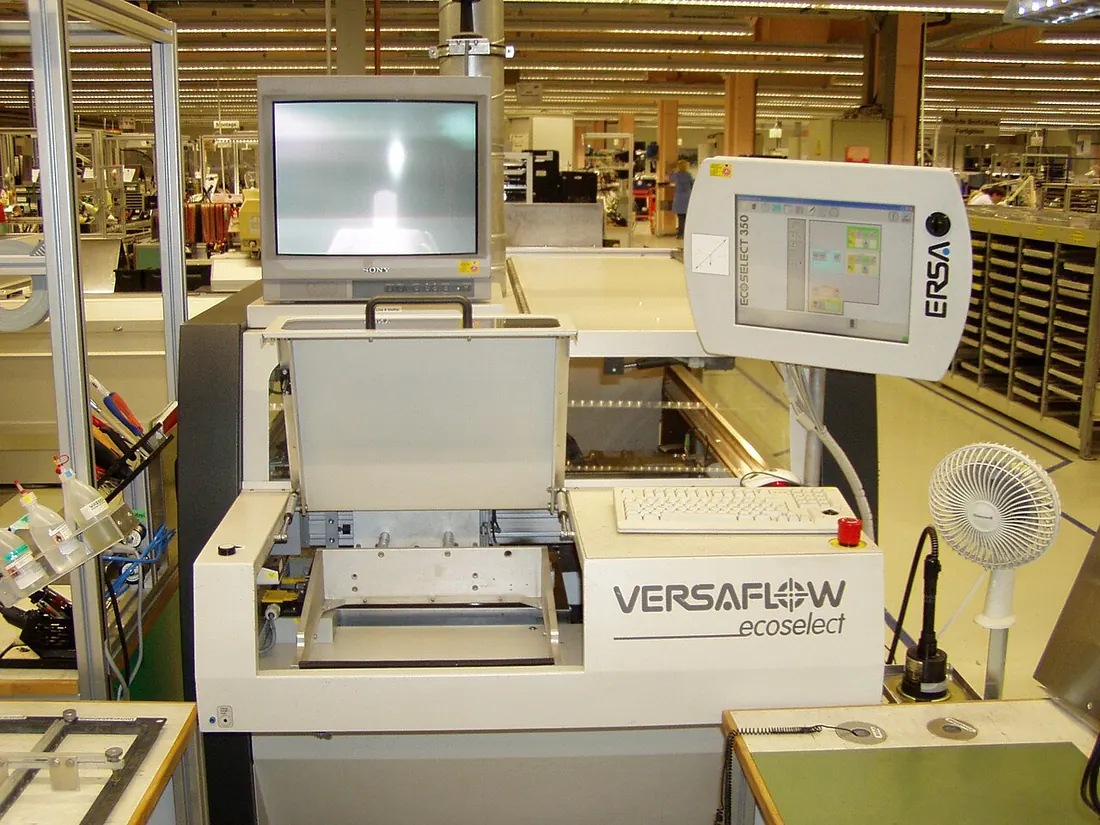

What it does
Passes circuit boards carrying through-hole and other suitable components over a molten solder wave, forming joints in bulk.
How it works
The conveyor carries boards through flux application, preheat and wave contact in turn. The solder pump forces molten alloy through a nozzle to form a wave, and the board's solder side contacts it, leaves and cools. Dual-wave machines use different flow patterns for wetting and solder separation.
Process sequence
- Load boards and confirm the solder side
- Apply flux
- Preheat
- Pass over the solder wave
- Exit and cool
- Check hole fill and excess solder
Key inputs
- Board and component heat limits, carrier masking
- Alloy and flux match
- Conveyor speed, wave height, contact position and preheat profile
Common problems
- Poor wetting and through-hole fill
- Bridges, icicles and solder balls
- Board distortion or wave height fluctuation
Limits of application
- Full-width waves and selective mini-waves are built differently
- Nitrogen inerting and dual waves are not standard on every wave soldering machine
Functional modules
Conveyor and carriers
Control board attitude and transit speed
Flux system
Treats suitable solder areas
Preheat system
Heats evenly to reduce thermal shock
Solder pot and wave
Supply molten solder and control contact
Manufacturer & technical sources
Continue with manufacturer product pages, operating principles and technical information for this equipment type.