
Servo press station
Uses an electric servo drive to perform interference-fit press-fitting, with in-process evaluation and OK/NG handling according to the process requirements; upstream cleaning and oiling and downstream tightening are not included. Hydraulic, hydropneumatic and pneumatic drives are alternative drive concepts and are compared separately.
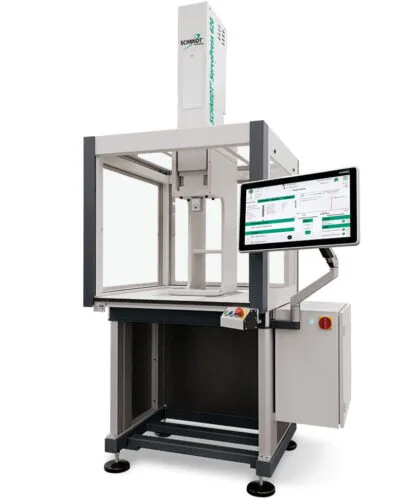

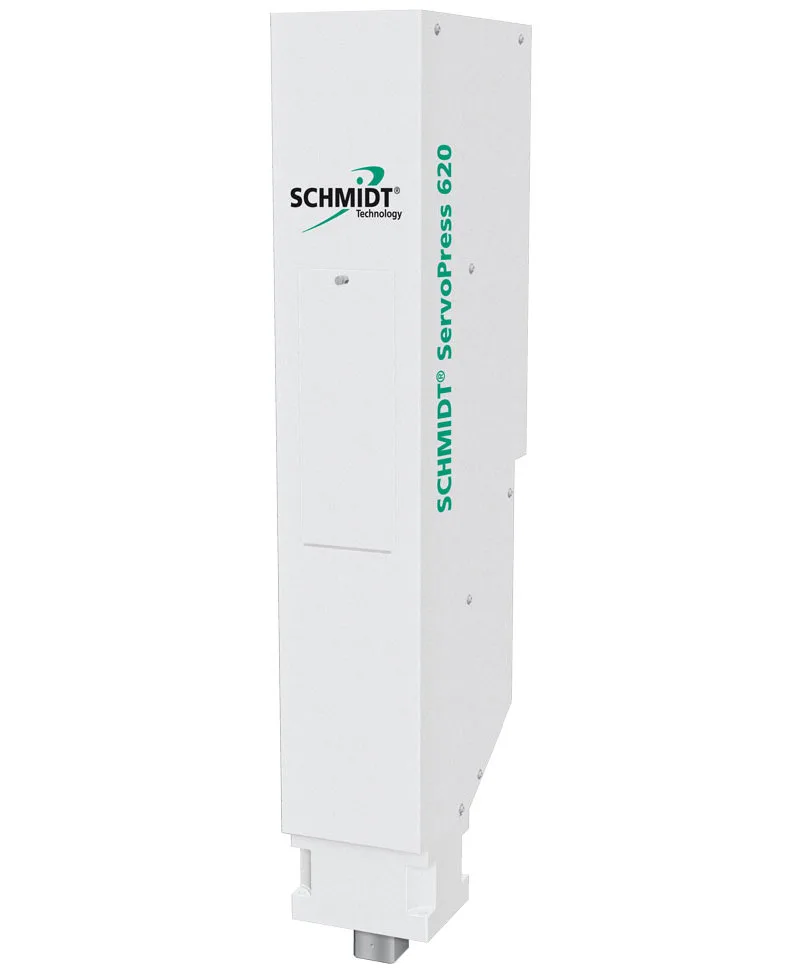
This article covers working principles, design inputs and selection questions. The parameter table lists measurements, definitions and references; values depend on the selected machine, workpiece and operating conditions.
Principle
The electric servo drive train provides the ram feed: a servo motor drives the ram through a coupling or timing belt and a ball screw (or a wedge-type force-multiplying mechanism).
The measurement chain acquires force and displacement, and the evaluation is based on these signals; the sensors may be shared with the servo closed-loop control or installed separately, and are recorded according to the actual configuration.
The statement in S4 that the press-fit monitoring system can be combined with various press cylinders is a compatibility statement for that system; it does not imply that every measurement chain is independent of the drive type.
Sequence & decision points
- 01
Loading and locating: the workpiece enters the fixture and is located on its datums.
- 02
Rapid approach: the ram descends to just short of the workpiece (set according to stroke and takt time).
- 03
Contact changeover (conditional step): if the process requires impact to be avoided, switch to slow working feed once the contact criterion is triggered; the criterion may be a force, displacement or drive-current threshold, and must be consistent with the measurement chain and calibrated.
- 04
Pressing: press in under position closed-loop, force closed-loop or combined control, while acquiring process data.
- 05
Dwell (conditional step): whether to dwell, the dwell time, and whether force or position is held are determined by the process and by sample-part validation.
- 06
Return and evaluation: the ram returns and OK/NG is output according to the configured evaluation method; OK/NG diverting is an optional step, configured according to the actual interface.
Modules & configuration items
- Drive and transmission (electric servo): servo motor and servo drive, coupling or timing belt, ball screw or wedge-type force-multiplying mechanism, guiding.
- Measurement chain: force sensor (strain-gauge or piezoelectric), displacement feedback (encoder or linear scale), monitoring unit or PLC, sampling and storage; record the specific devices, mounting positions, measurands and calibration conditions.
- Ram tooling and fixture: ram tool interface type and range of interchangeable tools; fixture locating datums and clamping method.
- Frame: C-frame or four-column, rated on the basis of the rated load and off-center load specifications, not inferred from the frame type name.
- Safety: determined by risk assessment; may be one or a combination of guards, safety door locks, safety relays, speed and torque limiting, light curtains and two-hand control.
Interfaces
- Upstream: loading and locating accuracy and workpiece datums; the fixture locating surfaces and the ram axis must be dimensioned to the same datum.
- Downstream: OK/NG diverter outlet and routing (optional); whether the takt time allows for dwell time.
- Data: curves, evaluation results, serial numbers; interface type (OPC UA, database, file, PLC registers) to be confirmed against the actual system.
- Pneumatic and electrical: air circuit (if there are pneumatic auxiliaries), servo power and encoder cables, safety circuit.
Design inputs
- Workpiece drawings, tolerances, interference, materials and contact conditions. Axial press-fit force required according to process validation (N/kN).
- Permissible press-in depth range, in mm; definition of the measurement datum.
- Evaluation method and windows: define the control mode (position / force / combined) and the force–displacement evaluation windows separately.
- Define actuator stroke and workpiece relative displacement separately; state the compliance under load.
- Traceability requirements and data interface.
Selection questions
- Drive type: servo, hydraulic, hydropneumatic or pneumatic — decide on the basis of the equipment's rated load, speed and position-control requirements and the validation conditions, not by assigning tonnage and cost ranges to drive names.
- Measurement chain: direct force measurement or indirect measurement via structural strain? Range, overload protection, calibration interval.
- Which sensor provides displacement feedback, where is it mounted, and which two measurement datums does it reference? If workpiece relative displacement is estimated from actuator stroke, the compensation must be validated against a measured force–deformation relationship and the load path; if workpiece relative displacement is measured directly, record the sensor datum and the validation result.
- Evaluation method: fixed windows or envelope curve, calibrated with sample parts.
Pitfalls
- Looking only at peak force and not at the curve shape.
- Converting hydraulic circuit pressure or supply air pressure into axial force and then using the converted value as if it were a directly measured force; an estimate is acceptable, but the measurement point, effective areas, differential pressure between the two chambers, friction and other applicability conditions, together with the uncertainty, must be stated.
- Ignoring the effect of elastic deformation of the frame and tooling on the displacement reading; the magnitude and direction of the error are determined by the sensor datum and the load path, and are not presumed to be an over- or under-reading.
- Setting curve windows by experience without repeatability and reproducibility validation.
- Sensors left uncalibrated for long periods, so that zero drift shifts the whole window.
- Treating “axial press-fit force keeps rising after bottoming out” as a normal in-position signal, with evaluation limits not set by process and sample-part validation, which creates a risk of crushing the parts (S3).
- Treating a single safety device as a safety solution that is sufficient for any station.
Handover checklist
- Correspondence between the workpiece drawing revision and the process sheet revision.
- Ram tool and fixture drawing revisions, interface type and re-inspection items.
- Register the four release baselines separately — drawings, process, control program, evaluation windows — each with an identifier and revision number; on any change, update the baseline references and re-verify.
- Measurement chain checklist: specific devices, mounting positions, measurands, range, overload protection, calibration interval, calibration certificates, force measurement method (direct / indirect).
- Description of the displacement feedback method, sensor datum and measurement datum; if compensation is used, state that it is a validated force–deformation calibration.
- Sampling rate and evaluation window parameters (state the layer to which the sampling rate belongs and its source).
- Register axial press-fit force (N/kN), displacement (mm), hydraulic circuit pressure (MPa, state the measurement point) and supply air pressure (MPa, state the measurement point) as separate fields.
- I/O list and safety circuit description.
- Data interface and fields (including whether data are uploaded to MES).
- List of good and defective sample parts and detection capability validation records.
- Changeover work instructions and first-article re-verification items.
- Fault recovery description: handle mid-cycle NG, axial force over-limit, circuit pressure over-limit, missing part and sensor fault separately.
- When fluid pressure is used to estimate axial force: multiply each chamber pressure by its own effective area and take the difference according to the direction of action; state friction, operating conditions and uncertainty; the gauge pressure in the supply air main is used only to verify the air supply and is not used to calculate axial force.
- Datum chain description (workpiece datum, fixture datum, ram axis) and measured coaxiality.
- Register the control mode and the force–displacement evaluation windows separately.
- Record the mounting and calibration conditions of the measurement chain. For hydraulic circuit pressure and supply air pressure, state the measurement point and purpose of each separately.
Parameter record
The table lists parameter definitions and measurement references. Undecided or unmeasured values stay empty; ratios are not calculated when the denominator is zero.
| Field | Unit | State | Definition & basis |
|---|---|---|---|
| axial_force | kN | To measure | Estimate axial press-fit force from interference, contact geometry, materials and friction; establish the final value by process validation. |
| press_depth | mm | To measure | According to the workpiece drawing tolerances; the measurement datum is to be defined |
| hydraulic_pressure | MPa | To measure | For a hydraulic drive, register the circuit pressure separately and state the measurement point; do not mix it with the axial press-fit force |
| air_pressure | MPa | To measure | Register the supply air pressure separately and state the measurement point; it must not be converted directly into axial force |
| sampling_rate | Hz | To measure | Per project validation; if a vendor example is cited, state its scope of application and source |
| force_measure_method | - | To measure | direct (measured directly in the force flux) / indirect (measured indirectly via structural strain) |
| displacement_error | mm | To measure | The magnitude and direction of the error are determined by the sensor datum and the load path; no direction is presumed |
| judge_window | - | To measure | Fixed windows or envelope; parameters calibrated with sample parts |
References
References link each statement to its original source and location. Vendor performance claims apply to the cited model and conditions.
A servo motor drives a high-precision ball screw; a pressure (force) sensor at the front end of the ram acquires real-time pressure (force); position and pressure (force) monitoring; stages A and B; risk of crushing when the pressure (force) keeps rising after the part is pressed home; this application acquires data at no less than 1000 times/s
Location: Body text, paragraph explaining how the servo motor drives the bearing press, and the paragraph on quality inspection requirementsScope and notes: 1000 times/s is only an example for the cited application and does not represent all press-fit conditions. https://www.sz-taiming.com/Article/zcsfyljzlt_1.htmlThe press-fit monitoring system can be combined with hydraulic, hydropneumatic, pneumatic or electric press cylinders; the sensors can be mounted in the cylinder or indirectly on the C-frame / tool holder; the page lists “Up to 20 measurements per second”
Location: Press-fit section and the advantages listScope and notes: The source's “Up to 20 measurements per second” is not defined as the number of curve sample points. https://www.kistler.com/CA/en/sensors-and-process-monitoring-in-production/C00000059Press-fit force can be measured directly in the force flux or indirectly via strains in the machine structure
Location: Force measurement section https://www.kistler.com/CA/en/force-displacement-measurement/C00000111A servo motor drives a high-precision ball screw, with closed-loop control of press force and press-in depth throughout; heating, curve display and barcode scanning are available as options
Location: Product page, servo press sectionScope and notes: Only its description of the mechanism and configuration is cited; promotional comparisons are not taken as general conclusions. https://www.sz-taiming.com/Products/sfyj.html
Project decisions to confirm
- Actual values of axial press-fit force, stroke, displacement repeatability, force control accuracy and sampling rate: null, pending binding to a specific machine model and sample parts.
- Whether to dwell and the dwell time: pending process validation.
- Whether data are uploaded to MES and the interface type: to be confirmed against the actual system.
- Comparisons between hydraulic, hydropneumatic, pneumatic and electric solutions must be tied to specific machine models and operating conditions; a solution category cannot substitute for a performance comparison.
Aggregated references: models, makers, patents & videos
References scattered across model articles, vendor sites and patent databases, gathered under this machine. Checked items are listed; the rest are offered as ready-to-open searches.
Equipment and core-unit manufacturers2
Manufacturer references for whole machines, subsystems and related processes; each item states its scope.
- Kistler
Press-fit monitoring and servo press systems
- Xintaiming
Servo presses
Patents: how others built it3
The patents below were checked against their abstracts and are listed for their mechanisms; scope and legal status are stated at the source.
- Servo press-fit mechanism for eccentric shaftsInvention · CN121104611B · 2026-07-10Jiangsu Fenghesheng Intelligent Technology Co., Ltd.Why it matters: The rotary table indexes by 180°. A lift supports the workpiece from below during pressing. A vibratory bowl and loading robot feed the eccentric shafts.
- Servo press-fit mechanism for stator and rotor assemblyInvention · CN122394307B · 2026-10-09Suzhou Tongjin Precision Industry Co., Ltd.Why it matters: A shaft-guided moving plate carries the rotor clamp, changeover fixtures and press head. A lift below the table aligns the stator and rotor concentrically.
- Servo press-fit assembly for vehicle lampsUtility model · CN224764746U · 2026-09-18Danyang Rongfei Automation Equipment Co., Ltd.Why it matters: A servo motor drives both screws through a belt. The screw nuts lower the plate onto the vehicle lamp. The plate carries mating components and downward-acting cylinders.
Videos: see it run
No licensed video is hosted for this machine yet; these searches are pre-filled with its name.
3D models and download information
Explore structure and assembly with models. Download methods, file formats and terms are provided by the original article or mini program.