
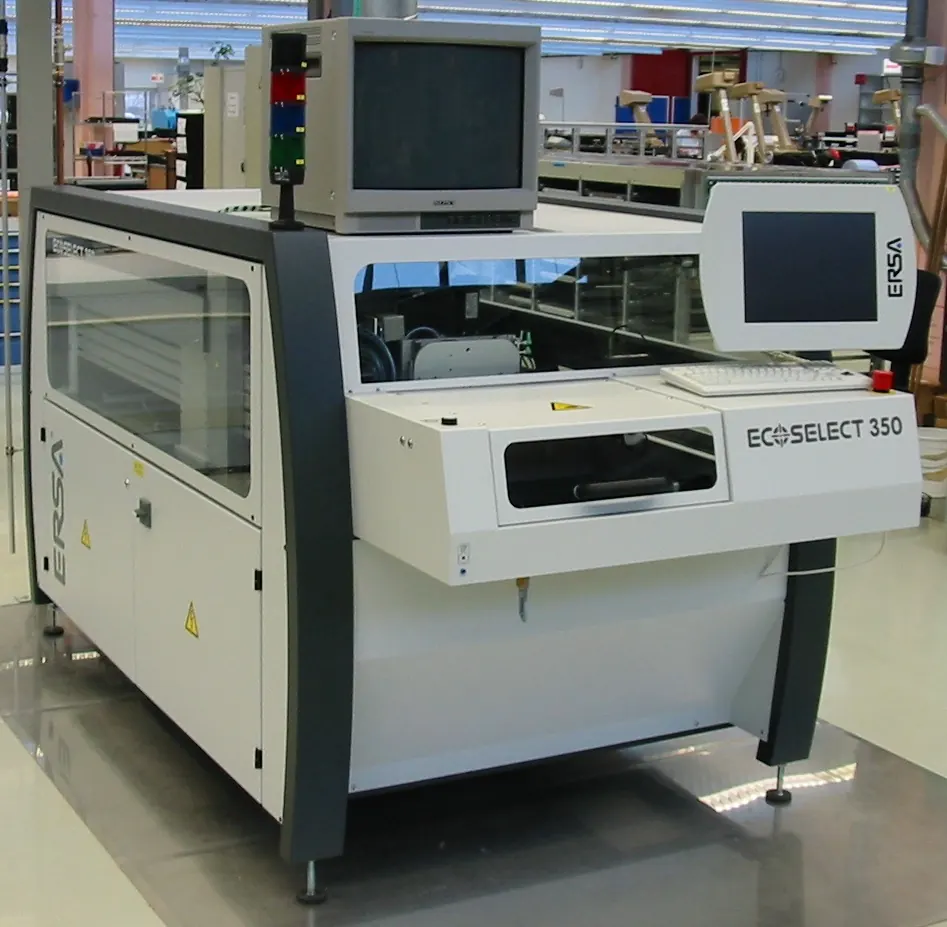

What it does
Applies flux and molten solder locally to selected through-hole joints on a circuit board, reducing the effect on nearby components.
How it works
Selected areas are fluxed and preheated, then the wave from a small solder nozzle contacts the target joints. Relative motion between nozzle and board sets the soldering path; multi-nozzle tooling can also handle a group of joints at once.
Process sequence
- Locate the board
- Flux target areas
- Preheat
- Nozzle follows the path to contact joints
- Lift off and cool
- Check wetting, hole fill and bridging
Key inputs
- Through-hole layout, neighbouring component height and access
- Alloy, flux and board heat capacity
- Nozzle type, contact time and motion path
Common problems
- Nozzle access blocked
- Insufficient preheat or flux causing poor hole fill
- Unstable lift-off or solder flow causing bridges
Limits of application
- Point-by-point mini-wave and custom multi-wave simultaneous soldering differ in cycle and tooling
- It is not passing the whole solder side over a wide wave
Functional modules
Selective fluxing
Delivers flux to target areas
Preheat module
Sets board thermal conditions
Solder pot, pump and nozzle
Form a stable local solder flow
Motion and positioning
Manages nozzle position relative to joints
Manufacturer & technical sources
Continue with manufacturer product pages, operating principles and technical information for this equipment type.