
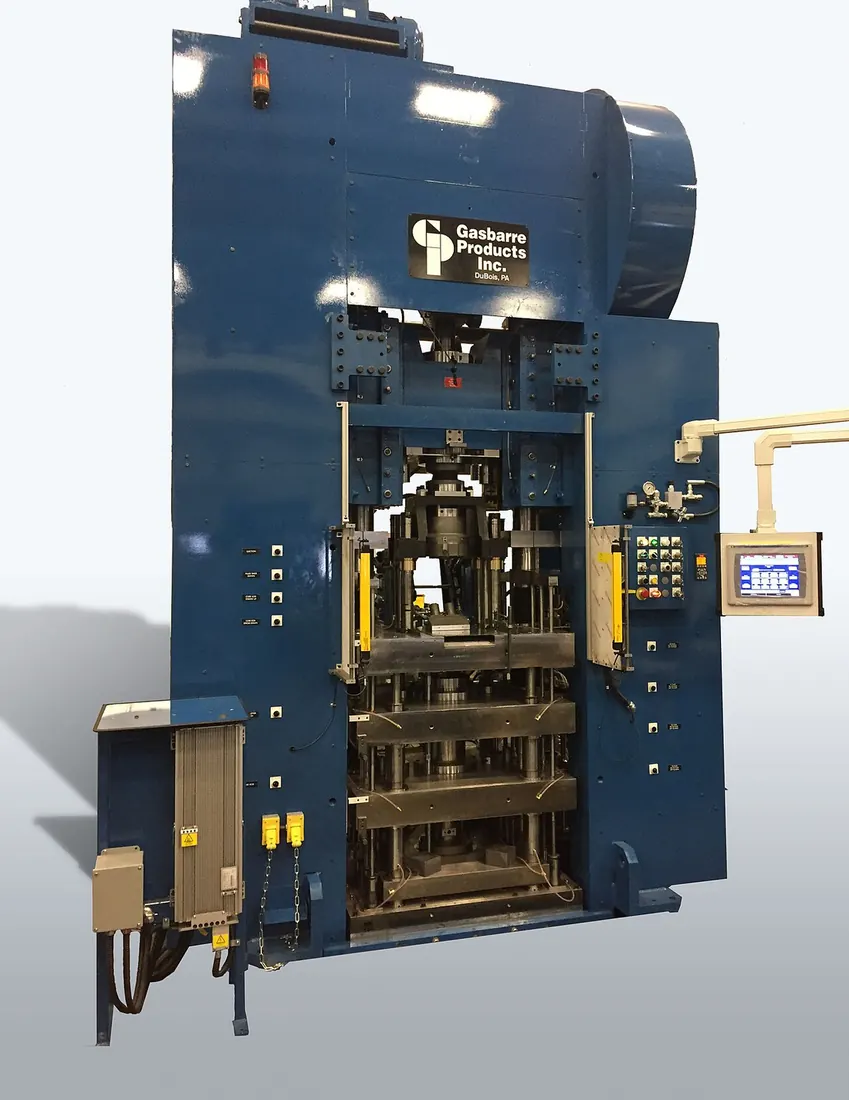

What it does
Fills a rigid die with a specified powder and compacts it, producing green compacts ready for handling and sintering.
How it works
The feed shoe sets the powder amount in the cavity, and relative motion of upper and lower punches rearranges and densifies the particles. Density distribution depends on filling and die wall friction; ejection may push out with the lower punch or withdraw the die relative to it, and the motion must avoid cracking the still fragile compact.
Process sequence
- Fill the specified powder amount
- Set punch and die positions
- Compact and control each level
- Unload under control
- Eject or withdraw the die
- Take off gently and inspect
Key inputs
- Powder flow and lubrication
- Fill height and level geometry
- Target green density
- Tool motion, ejection and later sintering
Common problems
- Fill bridging or segregation causing density differences
- Die wall friction affecting compaction
- Elastic recovery on unloading causing cracks
- Take-off damaging weak edges
Limits of application
- This page covers uniaxial pressing in rigid dies
- Isostatic pressing uses flexible moulds and a pressure medium and is built differently
- A green compact does not have the strength of the final sintered material
Functional modules
Hopper and feed shoe
Fill the cavity
Die, punches and core rod
Define shape and compact
Pressing drive and control
Coordinate force and displacement of each level
Ejection and take-off
Protect compacts in transfer
Manufacturer & technical sources
Continue with manufacturer product pages, operating principles and technical information for this equipment type.