
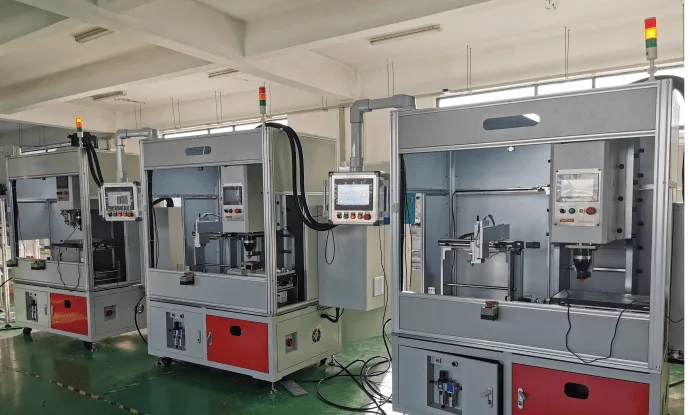

What it does
Joins the shafts, rivets and plates of vehicle locks in position while keeping the clearance rotating parts need.
How it works
The latch and pawl of a door lock rotate about their rivets, whose ends are fixed in the base or back plate. The fixture first holds plates, springs and axes, then the forming head makes the rivet end flow plastically into a head; with orbital forming, a tilted tool circles the axis in local contact while the anvil takes the reaction.
Process sequence
- Stack plates and springs in order
- Insert and locate pins
- Set anvil and fixture
- Rivet the ends under control
- Retract the head
- Check heads and rotation
Key inputs
- The lock's specific shafts and washers
- Rivet material and free end length
- Support, head profile and joint clearance
Common problems
- Over-riveting binding rotating parts
- Under-riveting coming loose
- Off-axis forming, misplaced springs and poor support
Limits of application
- Internal lock pivots and the base plate of a door striker are different riveted parts
- Orbital, radial and direct press riveting move the tool differently and are chosen by joint requirements
Functional modules
Plate and pin locating
Sets bore axes and part order
Riveting anvil
Supports the loaded end
Forming head
Controls end deformation
Motion check
Confirms rivet retention and joint movement
Manufacturer & technical sources
Continue with manufacturer product pages, operating principles and technical information for this equipment type.