

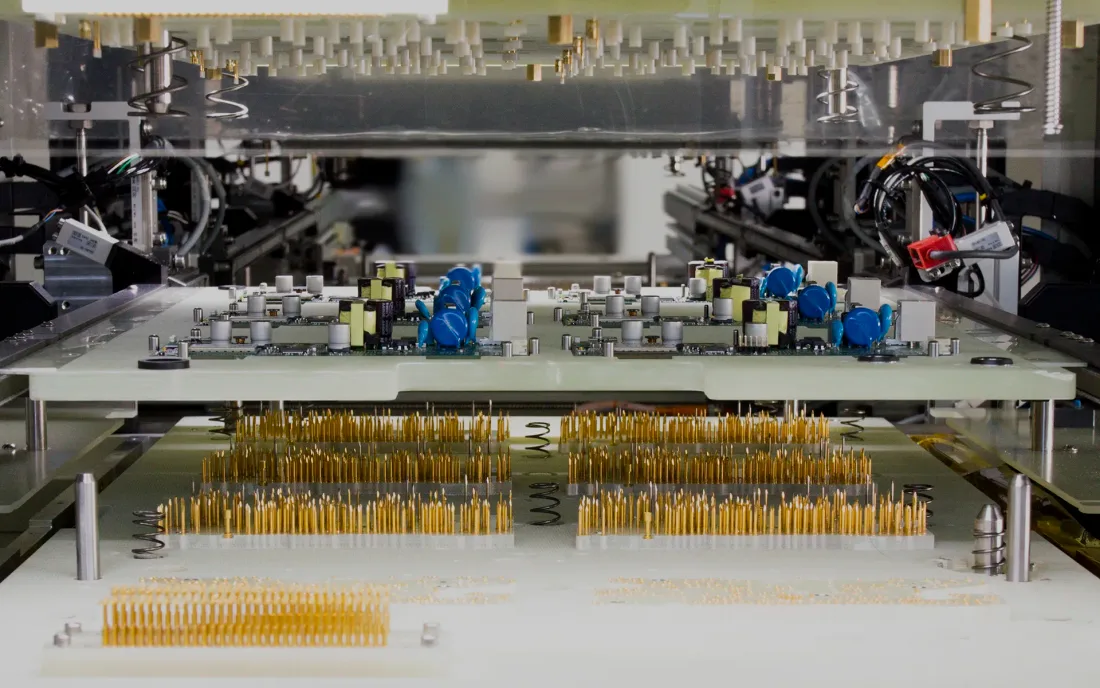
What it does
Connects the test system to circuit board test points through a custom probe array, creating a repeatable mechanical and electrical interface for in-circuit structural testing.
How it works
Tooling pins and supports align the board with probe coordinates, and the press mechanism compresses spring probes to the specified working travel. The tester applies signals and measures through these contacts to check suitable components or connections; the bed of nails is only an interface, not a test algorithm in itself.
Process sequence
- Load the board and confirm error-proofing
- Locate and press down
- Check contact
- Run structural tests
- Record faults
- Release and remove the board
Key inputs
- Test point access and board tolerances
- Probe type, compression travel and total reaction force
- Support layout, test nets and channel mapping
Common problems
- Dirty or worn probes causing open contacts
- Board warp and total probe force causing damage
- Mapping or support errors causing false failures
Limits of application
- Bed-of-nails and flying probe are different contact methods
- ICT coverage is limited by test points and nets and cannot guarantee full board function coverage
Functional modules
Board locating and support
Keep test points matched to probe positions
Spring probe bed
Makes repeatable multi-point contact
Pressing and stops
Set probe compression and limit board bending
Interface wiring
Connects probes to tester channels
Manufacturer & technical sources
Continue with manufacturer product pages, operating principles and technical information for this equipment type.