
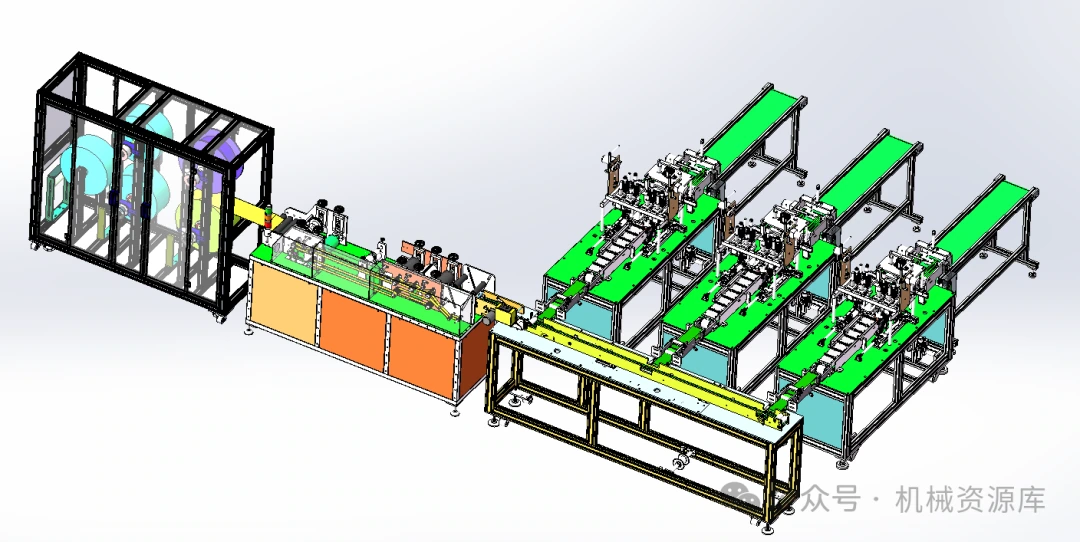
What it does
Makes flat face masks with fixed ear loops from multilayer roll material.
How it works
Roll materials are aligned and pleated, ultrasonically edge-sealed and cut, and a separate ear loop station welds the attachments.
Process steps
- Thread and align rolls
- Pleat layers and place the nose wire
- Seal the edges
- Cut to length and divert
- Weld ear loops and collect
Key inputs
- Number and orientation of layers
- Unfolded mask shape
- Welding window
- Ear loop attachment type
Common misconceptions
- After forming and welding, filtration performance, fit and product certification of the finished mask still need separate evaluation.
Limits of application
- Flat masks rely on pleats to unfold, while cup masks use a different 3D forming process.
- Output depends on materials, welding conditions and the combination of stations.
Functional modules
Multi-roll unwind
Unwinds each layer and feeds the forming section continuously.
Alignment and pleating
Aligns layers and forms the pleats of the mask body.
Nose wire feeding
Feeds the nose wire into position in the material.
Ultrasonic bonding and cutting
Joins the layers ultrasonically and cuts single mask bodies.
Ear loop welding
Attaches ear loops at specified positions on the mask body.
Manufacturer & technical sources
Continue with manufacturer product pages, operating principles and technical information for this equipment type.